The state of health care and adult social care in England 2025/26
Downloads
Adult social care workforce
Recruitment and retention
Data from CQC’s provider information returns for care homes shows that across 2025/26, average staff vacancy rates in care homes were at 4.6%, a very small reduction on 4.8% in the previous financial year. In real terms, this means almost 1 in 20 care home roles remained vacant in 2025/26.
Staff turnover in care homes also continues to reduce. Across 2025/26 average staff turnover was at just over 23%, down nearly 2 percentage points from the previous year.
There is more regional variation in levels of turnover for care home staff than in vacancy levels. Regionally, the North East and Yorkshire region has the highest staff turnover in care homes at 27% for 2025/26, which is 4 percentage points higher than the national average. Meanwhile, London continues to have much lower staff turnover rates in care homes compared with the rest of the country – averaging 16% over 2025/26, which is 7 percentage points lower than the national average and 11 percentage points below the North East and Yorkshire region.
Our provider information returns for homecare services show a small reduction in staff vacancy rates in homecare services: reducing from 11% to 9% between 2023/24 and 2024/25, and then remaining static at 9% over 2025/26. In real terms, this means almost 1 in 10 homecare roles remained vacant in 2025/26.
The data also show a small but continuous reduction in the staff turnover rate for homecare services in England, from 21% to 19% between 2023/24 and 2025/26.
Although the reductions in staff turnover seen in care homes and homecare services are encouraging, it still means that almost 1 in 4 care home staff and 1 in 5 homecare staff left their job in 2025/26. This can have a negative impact on the continuity of care and the ability to build trusted relationships with people.
In the State of the adult social care sector and workforce report 2024/25, Skills for Care identified a range of factors from its workforce data collection that were most associated with higher levels of staff turnover. These included longer distances to travel to work, lower pay, being aged under 25, and lower levels of experience, training and qualifications.
Although the data show reductions in vacancy and turnover rates, this can mask the challenges that providers and people using services experience. Analysis of our inspection reports that resulted in a rating of inadequate for the safe key question in 2025/26 found that these services did not always operate safe recruitment practices or maintain effective oversight to ensure they identified and managed risks. Recruitment processes were not always followed in line with regulatory requirements or providers’ own policies, and governance systems did not provide sufficient assurance that staff were suitable to work with people.
We saw examples where application forms from staff did not include a written record of any employment history. This meant managers were unable to assure themselves that staff had the appropriate skills, experience, or competencies to deliver safe care.
In addition, essential pre-employment checks, such as a Disclosure and Barring Service check (DBS), were not consistently completed or were sometimes delayed for months while staff were supporting people, exposing them to potential abuse and avoidable harm.
By contrast, services we rated as outstanding for the safe key question in 2025/26 were found to be actively promoting a career in adult social care, and creating a culture where staff feel valued, supported, and cared for within their roles, as the following example shows:
Where they wished to, staff were supported to follow the career pathway within the organisation, and the registered manager told us how staff had been supported to develop and [were] promoted in-house… The manager shared examples of how staff were supported in their roles, including providing emotional support during difficult times such as bereavement, and holding open and supportive discussions about working hours. Staff told us how they were proud working for the service. A staff member told us, 'The [homecare service] is like a big family, which I'm honoured to be a part of'.
(From a CQC inspection report)
International recruitment
While a continued national reduction in vacancy and staff turnover levels in social care is positive, concerns around the long-term sustainability of the social care workforce remain.
International recruitment has played a vital role in supporting the capacity of the social care workforce and reducing vacancy rates from a peak of over 10% in the aftermath of the pandemic. The valuable contribution of workers from overseas to the delivery of social care in recent years cannot be over-emphasised.
However, international recruitment into the social care workforce has continued to decline following changes to the Health and Care Worker visa policy in March 2024.
International recruitment into the workforce more than halved between 2023/24 and 2024/25 falling from 105,000 to 50,000. Over 2025/26, quarterly estimates published by Skills for Care show that international recruitment into the sector has fallen by a further 40% to just over 30,000 over the year.
The cessation of the Health and Care worker visas followed by increases in Home Office revocations of visa licences (see below) is driving worries that the pressures on staffing levels could spike again.
Although social care workers are no longer able to apply for Health and Care Worker visas to come to the UK, international recruitment into the sector is still continuing, albeit at much lower volumes, through other routes such as people on student visas.
Data from Skills for Care shows the social care sector has become increasingly dependent on non-British care staff and staff recruited internationally in recent years. With staff vacancy rates remaining around 3 times higher than the wider UK economy, the continued decline in overseas recruitment could worsen staffing pressures, affecting continuity of care, workforce stability, and the sector’s ability to meet growing needs.
When asked to select from a list the most important barriers to recruitment and retention that needed to be addressed, 24% of respondents to the April 2025 Adult Social Care Workforce Survey identified “immigration rule changes which have reduced the volume of applications”, while 15% identified “immigration rule changes which have impacted retention”.
More work is needed to strengthen recruitment and retention strategies, including through negotiations around Fair Pay agreements and implementing effective interim measures to support recruitment and retention while waiting for Fair Pay agreements to come into effect in 2028.
Care providers that have recruited staff internationally require a licence to sponsor care worker’s visas. Where abuse of the immigration system with regards to these visa sponsorship licences is identified, the Home Office will act to suspend or revoke the provider’s licence. The Home Office notifies CQC of their suspension and revocation activity so that we can consider this during our day-to-day regulatory work, such as the risk to people using the service.
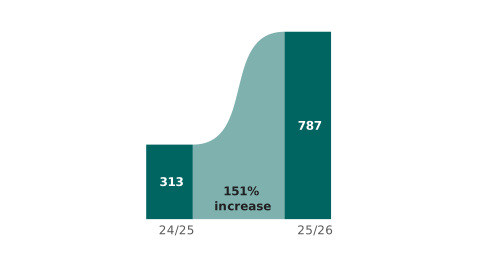
Home Office UK Visas and Immigration (UKVI) data at the end of May 2026 shows that we were notified of the visa sponsor license being revoked, and not subsequently reinstated, for 787 services (the majority of which were adult social care) over the course of 2025/26 (figure 15). This is 2 and-a-half times as many as in the previous financial year. These revocations of sponsor licences were for a range of reasons, with large volumes related to incorrect salary payments, while smaller numbers related to exploitative practices, such as debt bondage and concerns that vacancies being filled were not genuine.
Given the tenuous stability of the social care workforce and reliance on internationally recruited staff in some areas, there are concerns that large scale abuses of immigration rules by care providers and subsequent revocations of visa licences could impact the stability of the social care workforce within local areas.
Figure 15: Notifications of visa licence revocations have more than doubled in a year
Number of notifications to CQC of visa sponsor licence revocations, 2024/25 to 2025/26
Source: Home Office, UKVI data (supplied in May 2026)
Staffing levels
Through analysis of our inspection reports we have seen stark differences in people’s experiences of using adult social care services where they relate to the workforce. Where staffing was well managed, people were much more likely to experience safe, consistent and person-centred care, with good continuity and meaningful relationships with staff. This supported positive outcomes, increased satisfaction, and improved people’s quality of life.
In these services, providers made sure there were always enough qualified, skilled and experienced staff, with well-planned rotas and sufficient travel time between visits for staff working for homecare services. Staff told us that, “we have enough staff… we have time to sit down and talk to people”, and people confirmed this, saying “there are always staff around to talk to” and “they always turn up on time”. Good practice included consistent staff teams, effective matching of staff to people, and tools for monitoring staffing levels and responding when people’s needs changed, as the following shows:
[Care home] staffing was deployed with exceptional flexibility, shaped entirely around people’s individual needs and preferences. This meant staff were readily available at the times people wanted support, enabling them to choose what they wished to do and when they wished to do it… One person told us, “The staff are very kind, they have lots of patience”… One relative said, “The care is very consistent, [family member] has the same carers and they know us. They know what [family member] likes, they have made the decision for care easier for the family.
(From a CQC inspection report)
People and relatives described the care delivered from a small team of [homecare] staff who kept a close eye on everything. There was consistency, care staff were proactive and seemed to work well together and had good communication skills. The provider ensured new staff were introduced to people. A person said, “There is a small team of care staff allocated to me, so it does change, but I have never had a stranger walk into my house.
(From a CQC inspection report)
When providers did not ensure there were enough staff working who were suitably qualified, skilled and experienced to safely meet people’s needs, their staffing levels could fall below those needed for people who have a specified staffing ratio to meet their needs.
Rotas could also fall below the provider’s own safe staffing levels, and in some cases did not accurately reflect the staff on duty. In one example, inspectors saw that there were fewer staff working on each shift than the provider had told both CQC and the local authority.
The impact of staffing levels on the quality of care were commonly highlighted in our analysis of breaches of regulations in services rated as inadequate for the safe key question, where those that had breached regulations had failed to ensure sufficient numbers of suitably skilled and competent staff or had allocated staff poorly. This meant that people experienced delays, inconsistent care, and increased risk of harm, particularly where their needs required timely or specialist support.
Staff told our inspectors about their experiences of these pressures, stating there were not enough staff to support people’s needs, and that they didn’t get time to sit and chat with the people they were providing care for. Our inspectors also observed this, including call bells ringing for a long time and visitors having to step in where there were no staff around:
We observed a visiting relative intervening when a physical situation between two people began to escalate and there were no staff in the vicinity. This placed the relative and people at risk of harm.
(From a CQC inspection report)
There had been a number of falls in the service, and we were concerned that if someone rang their call bell or activated a sensor mat to alert staff that they were attempting to walk, the limited number of staff on shift may not be able to react quickly enough to protect them from further harm.
(From a CQC inspection report)
Staff also described working long days and nights without taking appropriate breaks. In one example, they described working over 95 hours in one week or in another where rotas showed that one member of staff routinely worked 48 hours at a time (2 consecutive 24-hour shifts, including sleep-ins) without a scheduled break. In one week, they worked 3 sleep-in shifts (72 hours) without a break. In some inspections staff reported being pressured to cover excessive workloads:
Shift shortages are frequent and often ignored, with employees pressured to cover excessive workloads without adequate breaks or assistance. The result is not only burnout, but avoidable harm to those under our care.
Qualifications and training
In their 2024/25 State of the adult social care sector and workforce report, Skills for Care reported that only 56% of all social care staff had either partly or fully completed the Care Certificate. Care Certificate standards are a recommended tool to support minimum training, supervision and assessment that staff new to care (health and adult social care) should receive as part of induction. Furthermore, over half (54%) of staff providing care directly to people did not hold a relevant social care qualification in 2024/25.
Workforce development and access to qualifications are a key factor associated with improved staff retention. Skills for Care’s analysis shows that care workers with a relevant social care qualification were less likely to leave their roles, with 21% leaving within a 12-month period compared with 27% of those without a qualification.
Qualifications are also key to career progression within the sector. In September 2025, the Department of Health and Social Care published the Adult social care workforce skills survey of CQC-registered residential or homecare providers. This found that nearly 83% of respondents said qualifications were important when it comes to promoting care workers into management positions. Where survey respondents said there are barriers to investing in skill development for the current workforce, they most commonly highlighted the cost of training (82%) and time for training (56%) as barriers stopping this investment.
Releasing staff to receive training may be challenging because of shortages and the need to maintain service continuity. For example, inspectors in our focus groups highlighted how some people working in care homes are not paid to complete training, and have to complete it in their own time.
These pressures may present a wider systemic challenge within the sector. Where organisations are unable to invest in workforce development due to financial or operational pressures, this may affect workforce capability, staff retention, as well as the quality and safety of care being delivered. Our inspectors also commented on the implications of adult social care providers not being supported by local healthcare partners to undertake training to enable them to safely carry out healthcare activities. This can lead to people’s needs not being met and a reliance on emergency healthcare services, which could be avoided or reduced if collaboration was facilitated.
Meanwhile, unweighted Skills for Care data shows that only 38% of staff providing care directly to people had completed training in dementia care. This is notable given the large number of people who are living with dementia within adult social care settings. Recent findings from Alzheimer's Society highlight gaps in dementia training, with fewer than half of care staff receiving dementia training as part of their induction and many reporting limited confidence in delivering care. The report highlights concerns that training provision may be insufficient, with some care workers receiving minimal dementia-specific training. This reinforces the importance of ensuring staff are equipped with the skills needed to support people living with dementia effectively.
In March 2026, we published research on what good practice looks like in caring for people with dementia. This research highlighted the importance of having staff who know about dementia and how to provide proactive support. We will use the findings from this research, alongside our 2025 report on Health and social care support for people with dementia, to co-produce statutory guidance on delivering care for people living with dementia, which means that all CQC-registered providers across health and social care must follow it.
Music clearly plays a huge role in the lives of the residents, and it was incredible to see the carers and nurses not just providing care but creating a joyful, engaging atmosphere. Seeing them singing, encouraging residents to sing along, and even dancing – whether standing or just moving along in their chairs – was heartwarming. It's this kind of engagement, this sense of warmth and happiness, that makes such a difference in the lives of those living with dementia. It was a beautiful reminder that care is not just about meeting physical needs but about enriching lives.
(Online submission through Give feedback on care, commenting on a care home)
Our inspection reports demonstrate the importance of training. Services rated outstanding for the safe key question ensured they adhered to training requirements with full oversight of any gaps. These providers regularly monitored competency through audits, observations of practice or supervision, and staff described feeling confident and well-supported. Members of staff told us that “the training gives me the confidence to do my job”. People and relatives also reflected this, with feedback such as “all [staff are] trained extremely well” and “the knowledge and expertise of staff here is amazing.”
In a few services rated as outstanding for the safe key question, training had a direct positive impact on people’s outcomes from their care. For example, staff were able to recognise early signs of deterioration or distress and respond appropriately, reducing the need for restrictive interventions and improving quality of life, as the following shows.
The provider had recruited an ‘in-house’ accredited trainer… to offer responsive, year‑round education, adapting quickly to emerging needs. A relative told us, “The meticulous daily reporting, the regular contact with me, the training programme which requires all new carers to shadow for a time before going ‘solo’: all of this in combination gives me every confidence.
A member of staff told us, “They offer extra training for Parkinson's disease and dementia. The training gives me the confidence to do my job. The training has taught me that I do know what I am doing. For example, when a lady I cared for had a stroke. I knew something wasn't right and I didn’t hesitate in ringing. The training gave me the skills to be able to identify the stroke.
A second member of staff told us, “People with lived experience delivered training. The training taught me to not stand in front of the person; you give them the chance to have the first interaction with someone who they might meet, which I always remember.
(From a CQC inspection report)
We also found that providers had tailored their training to the individual needs of people using services in areas such as learning disability and dementia. In these services, the culture enabled staff to feel able to request training. This resulted in staff showing high levels of competence, for example on implementing the practice of ‘redirection’ in dementia care:
In instances where people became anxious or distressed, staff fully understood the needs of the person, enabling them to offer personalised care. A member of staff told us, “I’ve had dementia training with the company, where I learned about redirection when someone is confused. They gave us lots of examples, and I use redirection daily. For example, a person I support says “see my mum, see my mum”, I change what they’re doing, talk about something else, or switch the TV over. It’s all about engaging. They love Songs of Praise, and we sing the hymns together, clapping and singing along.
(From a CQC inspection report)
In contrast, many services we rated as inadequate for the safe key question did not always ensure staff had the necessary skills, knowledge or competence to safely meet people’s needs. Training was often incomplete, not aligned to people’s needs, or not translated into safe practice. This meant people were at risk of unsafe care and avoidable harm, as staff did not always have the knowledge or skills required. Evidence of this includes outcomes such as wounds going unnoticed, incorrect medicines being administered, and people being supported by staff who could not explain basic safety concepts, such as diabetes risks.
Across the inspection reports for services rated as inadequate for the safe key question, there were gaps in core and specialist training. For example, in one service, 19 staff had not completed training in preventing pressure ulcers, including 5 of the 6 staff caring for a person whose wound had gone unnoticed, placing them at risk of avoidable harm. In another service, none of the agency staff had received dementia training, despite the majority of people at the service living with dementia. Similarly, training gaps were identified in key areas such as epilepsy, diabetes, dysphagia and positive behaviour support, with one example where “only 6 out of 21 staff had completed epilepsy training despite multiple residents having epilepsy.”
In some cases, staff were undertaking care tasks without the required training or competence, placing people at risk of unsafe care, for example supporting people with their feeding tube, and a newly recruited care worker administering medicine before any recorded competency assessment was conducted. One member of staff at another service told us, “I have not received any training… but I have to show the new staff what to do.”
In contrast, a homecare service we rated as outstanding for the safe key question ensured that staff had suitable levels of training by using a “digital safeguard” on their rostering system, which ensured that before staff were allocated to people using the service, they had relevant training to the person’s specific, specialist needs.
The Oliver McGowan Code of Practice provides guidance to providers about how to organise training in learning disability and autism, including putting learning into practice. Many providers we speak with have accessed and achieved the e-learning element of training in learning disability and autism. We have seen some innovative and positive examples of providers working hard to ensure staff are able to meet the specific needs of autistic people and people with a learning disability who use their service.
However, there is still more to do. Not all providers are actively seeking appropriate training for their staff despite this being a requirement under Regulation 18 of the Health and Social Care Act 2008. This endangers the outcomes and wellbeing of autistic people and people with a learning disability who receive care from those services.
We will continue to use our inspections to assess the quality of training and competence of staff to deliver safe care in all settings.