The state of health care and adult social care in England 2025/26
Downloads
Fragmentation in community adult social care
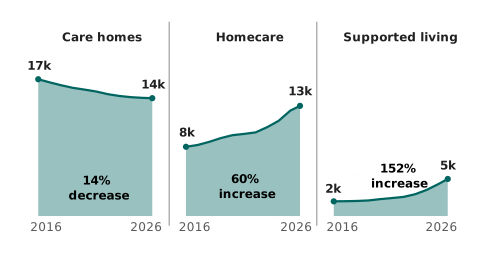
CQC’s register of active locations shows that the number of homecare services has continued to increase, reaching just over 13,500 in April 2026, an increase of 42% on April 2019, with an extra 700 homecare services registered in the last year nationally (figure 14). The growth in the homecare sector is reflected in data from our statutory Market Oversight scheme. This scheme assesses the financial sustainability of care providers that have a large local or regional presence, which local authorities could find difficult to replace if they fail and become unable to carry on delivering a service. Data from homecare providers in the scheme shows that over the 2 years from March 2024 to March 2026, there has been a 5.8% increase in the number of hours of homecare delivered.
Figure 14: The homecare and supported living sectors have increased hugely over the last 10 years, while the number of care homes has reduced
Number of care home, homecare and supported living services, April 2016 to April 2026
Source: CQC, HSCA register. Analysis uses a 3-month rolling average. Dormancy flag introduced in May 2021, dormant services are excluded from subsequent counts.
Enabling people to live more independent and supported lives in their own homes reflects the policy shift in local authorities that aims to commission more community services to support more people to stay in their own homes for longer, so the increases in care delivered in this model of care are encouraging.
Carers arrive morning and evening, giving personal care in a respectful, unhurried and loving way. My husband still has his dignity, and really looks forward to seeing them.
(Online submission through Give feedback on care, about a homecare service)
However, the homecare market is also increasingly fragmented, with the sector comprising a growing number of very small services. Analysis of the data we gather to determine our annual fees for providers suggests homecare services providing care to 4 or fewer people account for 30% of services in the market in April 2026, up 2 percentage points on last year.
Increased fragmentation is also reflected in commissioning practices, and this can present challenges for providers.
In last year’s State of Care, we reported that providers of homecare had been saying that commissioning of their services was an increasingly slow process and that commissioners were spreading care packages across a broader range of services. This had resulted in under-used capacity and was seen as one reason behind the small reduction in the number of hours of care delivered in data for the subset of providers in our CQC Market Oversight scheme where a direct comparison over time could be made.
Concerns around commissioning and under-used capacity are supported by evidence published by the Homecare Association in November 2025, which found the majority of local authorities across England purchased an average of 500 or fewer hours of care during a sample week. This is well below the 1,500 hours that their Minimum Price for Homecare model assumes is needed for a service to remain financially sustainable and delivering predominantly state-funded care. Commissioning delays and under-used capacity add to the financial drain for services, increasing sustainability pressures and driving the sector towards more self-funding clients.
However, there is some indication of improvement in this area. Our most recent CQC Market Oversight scheme data for the quarter ending March 2026 suggests this issue stabilised for providers in the scheme over 2025/26, with the final quarter of the year showing a small increase of 1.6% in hours of care delivered compared with 2 years earlier for the subset of providers where a direct comparison over time could be made.
We are keen to understand how changes in the homecare sector and increased complexity in commissioning affect people's experiences. Issues with commissioning are also highlighted in the following section on ‘Local authority baseline assessments’.
An increasing proportion of newly registered homecare services also provide supported living services, accounting for 27% of the homecare market (an increase of 6 percentage points in the last 2 years). Indeed, the Supported Living market continues to grow at pace. In last year’s State of Care report, we noted that the number of supported living services had increased by nearly 50% between 2022/23 and 2024/25. In 2025/26, the market has grown a further 20%, bringing the total number of registered supported living services to over 4,500 as at April 2026.
These findings about the fragmentation and diversification of the homecare market are also supported by research from LaingBuisson, which talks about “an increasingly diverse provider landscape, marked by the growth of supported living, the persistence of small-scale micro-providers, and ongoing shifts in how care is delivered between settings”.
A personal story – experiences of 2 homecare services
Joanne noticed a steady change in her father Raymond’s behaviour: he no longer looked after his diet or personal hygiene like he once did, and the food in his house had become mouldy. She also worried that he was becoming lonely. After he started having problems remembering to take his medication properly, he was assessed and diagnosed with Alzheimer’s disease.
After many difficult conversations with Raymond about his declining ability to live independently, Joanne found him some care at home, which he paid for privately. The service worked with Raymond for 18 months, during which time Joanne observed care delivered inconsistently, an unpredictable stream of carers, and seemingly untrained staff. She told us, “You never knew who was coming… there was no continuity”.
The carers were consistently late and didn’t stay with Raymond for the whole of their allocated shifts, as set out in his care package, and they regularly missed his medication doses. The service didn’t build a rapport with Raymond or Joanne, and Joanne felt that Raymond’s care “wasn’t person-centred… and wasn’t meeting his needs”. Joanne also noted a high turnover rate of care staff, and, despite her concerns, was advised to retain Raymond’s care with the service due to a high demand for other services.
Joanne tried contacting other local services and soon learned that it was very difficult. However, she eventually found a different homecare service that had capacity. Given their poor experience with the previous service, Joanne had to convince Raymond to make the transition, but the quality of care at the new service proved to be much higher.
For example, in contrast with the previous service, a core group of 6 carers at the new service consistently visit Raymond punctually, and for their whole shift. There seems to be “no real turnover of staff” and Joanne no longer feels the need to check Raymond’s medicines because the carers administer them to him consistently.
The carers have built a strong rapport with Raymond, “They… know him inside out” and seem to have received thorough training on interacting with people with his conditions and on meeting their needs with the use of specialist equipment. The service logs medication updates on a mobile app to assure Joanne of the actions that staff have taken while caring for Raymond.
Raymond’s care plan is reviewed regularly, and staff work with agility to update it when appropriate. Joanne says that in comparison with the previous service, this one is proactive, not reactive, “He's happier, he's more content; I'm more reassured, I feel that he's safe”. Both Raymond and Joanne are keen for Raymond’s care to continue in the community to retain a sense of personal independence and financial security.
(Interview with a member of the public)