The state of health care and adult social care in England 2025/26
Downloads
Adult social care ratings
The following analysis relates to 6,294 adult social care services (care homes, homecare and supported living) assessed under our current assessment framework. We have been using this framework since the beginning of 2024. During this time assessments have been largely risk based, so the services assessed may not be representative of all services across the sector.
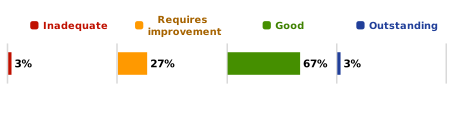
Our ratings of care homes as at August 2026 show that more than 7 out of 10 of the 3,783 care homes assessed under our current framework are providing good (67%) or outstanding care (3%), while the remaining care homes required improvement (27%) or are providing an inadequate care service (3%) (figure 8).
Figure 8: 7 out of 10 care homes are providing good or outstanding care
Proportion of care homes rated using our current assessment framework with an overall rating of outstanding, good, requires improvement or inadequate, August 2026
Source: CQC, ratings data
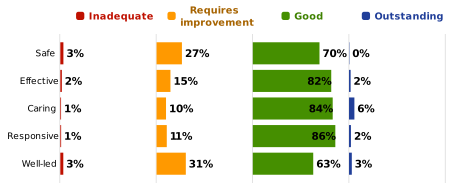
Around 9 in 10 care homes are rated as good or outstanding for providing caring (89%) and responsive (88%) support. However, we found the most common problems are related to their leadership, as around a third of care homes were rated as requires improvement (31%) or inadequate (3%) for the well-led key question (figure 9).
An analysis of our assessment data looking specifically at the quality statements under the well-led key question identified concerns in governance, management and sustainability in particular, with shortfalls in standards identified for more than half (55%) of the care home assessments that looked at this quality statement. This quality statement relates to the requirement for services to have clear responsibilities, roles, systems of accountability and good governance. In a focus group to inform this year’s State of Care report, CQC inspectors and specialists fed back that the key concerns included leaders not having the time and support they need to provide good oversight and drive improvements, and not listening to staff or acting on their feedback.
Figure 9: Leadership issues identified in a third of care homes
Key question ratings for care homes, rated using our current framework, August 2026
Source: CQC, ratings data
A personal story – a care home giving caring, flexible support
Abbie’s parents, Andrew and Mary, were in their early 80s and had long-term health conditions. When Andrew had to go to hospital, Mary had to stay with Abbie to be cared for. Abbie told us this separation was taking a toll on her parents, both physically and mentally, as they had been happily married for over 60 years.
Abbie took on the task of finding a care home that would be able to provide high levels of care for them both so they could be together. She described the search as being like a “minefield”, as many care homes in their area did not cater for their needs or cater for couples wanting to be together.
However, after many visits to care homes, she found a home that was “incredibly understanding and supportive” and was flexible to accommodate the couple together. Abbie explained how the home was very attentive to Andrew’s needs and placed him at the centre of his care, “They really wanted to know him holistically and not just his physical needs”. The care home manager also supported Abbie, who said, “A friendly pat on the arm and a cup of tea and an acknowledgement of what a daunting time it is was so refreshing and needed at such a traumatic time in my life.”
Mary sadly passed away in the home. Abbie said that the care home staff had enabled her to pass “very peacefully in the way that we would have all wanted for her”. The support the home gave to Abbie and her Dad following Mary’s passing was described as immeasurable. For example, the care home staff supported Andrew by “bringing him flowers, encouraging him to take part in activities, just listening to him talk, making sure he eats, and getting the chef to cook his favourite meals and snacks.”
Abbie is a frequent visitor at the home to see Andrew and has observed that “the management of the care home socialise with the residents; they are not locked away in their offices, they are genuinely interested in the care of their residents and families.” Abbie is incredibly grateful for the kind and compassionate care they have and are receiving from the home as a family.
(Taken from an online submission through Give feedback on care)
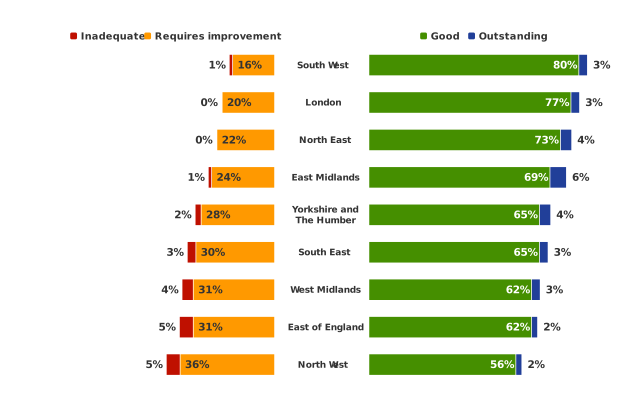
Regionally, for care homes assessed under our current assessment framework, those in the South West and London areas have the best ratings for the quality of care, with 82% and 80% rated overall as good or outstanding respectively. The North West has the poorest overall ratings for care homes, with only 59% of all assessed services rated as either good (56%) or outstanding (2%) (figure 10).
Figure 10: The quality of care homes varies across the country
Overall ratings for care homes rated using our current assessment framework by region, August 2026
Source: CQC, ratings data
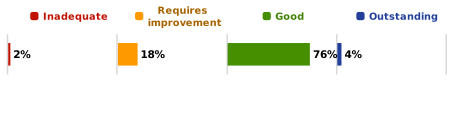
In the homecare sector, as at August 2026 we have assessed 2,121 services under our current assessment framework since January 2024. Of these, 80% have been rated as either good (76%) or outstanding (4%), while 18% were rated as requires improvement and 2% as inadequate (figure 11).
Figure 11: 8 in 10 homecare services are providing good or outstanding care
Overall ratings for homecare services using our current assessment framework, August 2026
Source: CQC, ratings data
We have assessed 390 supported living services since January 2024, of which, 78% were rated as either good (74%) or outstanding (4%), while 19% were rated as requires improvement, and 2% as inadequate.
An outstanding supported living service for autistic people and people with a learning disability
We assessed a supported living service providing support to autistic adults or adults with a learning disability, and rated it as outstanding for 4 key questions and outstanding overall.
Some people using the service were not able to tell us about their needs and feedback verbally, but staff and managers showed exceptional commitment to developing a deep understanding of their wishes, needs and preferences by using bespoke techniques to enable them to communicate these. Other people were able to tell us with pride about their achievements since moving to the service and spoke with excitement about plans for the future.
People’s relatives and professionals told us how much more independent and healthy people were. They told us people had been supported to visit family homes, in some cases for the first time in many years.
(From a CQC inspection report)