The state of health care and adult social care in England 2025/26
Downloads
Requests for adult social care and capacity in the sector
We have noted in previous years that local authorities have been facing an increasing number of requests for adult social care and support. We are unable to comment on how this trend has changed due to changes in data collection and statistical methodology. However, the latest official statistics published by the Department of Health and Social Care show that there were just over 2 million new requests for local authority-funded adult social care support in 2024/25. Around two-thirds of these requests related to adults aged 65 and over, while a third related to working-age adults (18 to 64 years old). As a single person can account for multiple requests, the data shows these 2 million requests related to 1.4 million people.
Regionally, new requests for local authority-funded social care in 2024/25 were highest in the North West and lowest in the South West. However, it should be noted that there may be some regional variation due to differences in recording data.
In 2024/25, no further action was taken, beyond providing information, in 7 out of 10 new requests for local authority-funded support (71%). Taking no further action was more likely in relation to requests from working-age adults (86%) than from older adults aged 65 and over (66%).
As these figures imply, older adults were much more likely to receive care than working-age adults in 2024/25:
- nearly a quarter (23%) of new requests from older adults received a short-term package of care, compared with 8% of requests from working-age adults
- 8% of new requests from older adults received long-term care, compared with 4% from working-age adults.
Support for people with a learning disability is the most common reason working-age adults are receiving long-term care (accounting for 44% of working-age adults receiving long-term care); for older adults the most common reason is for personal care (62% of older adults receiving long-term care).
The majority of local authority-funded long-term support is provided in community settings (mostly in people’s own homes) – 86% for working age adults and 61% for older adults.
There is regional variation in the rates of provision of long-term social care funded by a local authority:
- for older people: rates are highest in London and the North East, and lowest in the South East and South West
- for working-age adults: rates are highest in the North West and North East, and lowest in the South East and West Midlands.
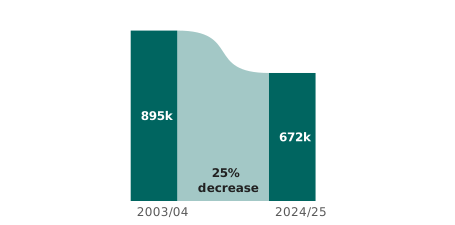
The number of adults receiving local authority-funded long-term social care at the end of 2024/25 was 25% lower than it was 20 years earlier, falling from nearly 895,000 at the end of 2003/04 to just over 672,000 at the end of 2024/25 (figure 12). However, local authorities have increased their provision of long-term support by 10% over the last few years since their lowest level of provision at the end of 2021/22.
Figure 12: Local authority-funded long-term social care has fallen by 25% in the last 20 years
Number of adults receiving local authority-funded long-term social care at the end of the financial year, England, 2003/04 to 2024/25
Source: Department of Health and Social Care, Adult social care activity report, England. The data collection methodology changed twice across the course of this time series