The state of health care and adult social care in England 2025/26
Downloads
Consolidation of the care home market
All providers that deliver a regulated activity in England must be registered with CQC. Using data from our register of locations, we have looked at trends in the number and sizes of care homes across England. These findings represent a considerable shift in the structure of the care home market.
Data on active locations that are registered with CQC shows that the total number of beds in care homes in England has remained broadly stable in recent years (fluctuating by 1% or less since April 2019), despite the total number of care homes falling by 8%.
However, the number of beds in care homes is being outpaced by an ageing population, which means the relative capacity in care homes is falling. For example, there were nearly 450 fewer care home beds per 100,000 adults aged 65 and over in April 2026 than there were in April 2019.
The data reflects the changing shape of the care home market, consolidating capacity in fewer but larger care homes. Between April 2012 and April 2026, the proportion of care homes that were large (with 50 or more beds) grew by three-quarters, from 13% to 23%, while their share of available care home beds grew from 59% to 70%.
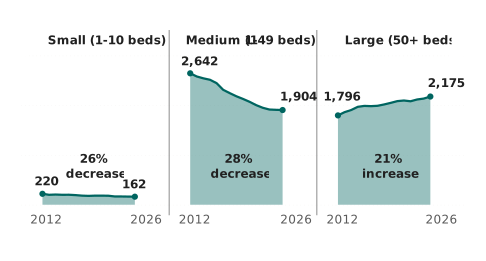
These changes are most marked in care homes providing nursing support. Between April 2012 and April 2026, the proportion of nursing care homes that were large (50 or more beds) grew from 39% to 51%, while small-sized services (1 to 10 beds) became rarer (from 5% to 4%). In February 2021, for the first time, the number of large nursing homes exceeded the number of medium-sized (11 to 49 beds) nursing homes (figure 13).
Figure 13: Care homes providing nursing support are becoming larger
Number of care homes providing nursing support by size, April 2012 to April 2026
Source: CQC, HSCA register
The data for 2026 shows that the proportion of small, medium and large nursing homes varies greatly between regions. Southern regions like London, the East of England and the South East have greater proportions of large nursing homes. In contrast, medium sized homes were slightly more common than large ones in the North West and Yorkshire and the Humber, and much more common in the East Midlands (by 17 percentage points)
Trends for care homes that do not provide nursing support show that medium and small-sized services remain more common than large ones. Although, there has been growth in the number of large-sized services here too, with the number of large sized care homes nearly doubling since 2012.
Within this context of growth in larger care homes, it is interesting to note that analysis of ratings for services assessed using our current assessment framework suggests that performance is better in large homes than medium-sized homes. In every region except London, a higher proportion of large-sized care homes that had been assessed received ratings of good or outstanding than medium-sized homes.
Reflecting on these findings, a focus group of CQC inspectors and specialists commented that medium-sized care homes may not have the financial stability and resilience of larger ones, or be able to invest to keep their buildings, systems and resources up to date. Some inspectors are seeing that medium-sized care homes have a high turnover of management staff, whereas larger homes may have a bigger leadership structure to improve governance. These issues can have an impact on the quality of care people receive.
It isn't a vast, showy place that brazenly shouts its glory across the rooftops: it is a comfortable, welcoming place that exudes a friendly, caring, nurturing atmosphere. It is clear that all staff care.
(Online submission through Give feedback on care, about a care home)
However, small care homes rated under our current assessment framework received the best ratings, with our inspectors and specialists commenting that small-sized homes may be able to operate more flexibly, and ‘think outside the box’ to make use of local community resources. It is notable then that the number of small-sized care homes reduced by more than 1,500 between April 2012 and April 2026, with the proportion of care homes that were small in size falling from 32% to 29% of the market over this period.
Small homes are often designed for specific care, such as to support autistic people and people with a learning disability. Analysis of nearly 700 small-sized care homes (10 or fewer beds) registered to care for autistic people or people with a learning disability that have been assessed since January 2024 shows that 80% are providing good (75%) or outstanding (5%) care. This is 9 percentage points better than the overall ratings for all care homes that have been assessed through the current framework.
An outstanding care home for autistic people and people with a learning disability
We rated a small residential care home providing support to autistic adults or adults with a learning disability as outstanding in all key questions in our assessment.
Staff consistently used kind, reassuring approaches and demonstrated a genuine understanding of each person, including their preferences. The provider also prioritised education, personal development and upskilling, ensuring people were supported to learn both practical and life skills. All relatives we spoke with said they were extremely happy with the provider. They described notable positive changes in their loved ones since living at the home, including improvements in confidence, emotional stability, independence, engagement and quality of life.
(From a CQC inspection report)
The reduction in the total number of care homes, combined with the growth in larger homes, comes in the context of recent increases in consolidation in property ownership by institutional investors.. Between September 2024 and September 2026, the number of homes owned by the top 5 largest providers of care homes for older people increased by 26%, driven primarily by transactions between one US-based real estate investment trust (REIT) with 3 of the largest providers. Our data shows that this REIT is now the dual-registered operator and owner of care homes which, in total, represent 9% of all CQC-registered care home beds in England.
Given the scale of these recent acquisitions, the Competition and Markets Authority (CMA) launched an investigation in January 2026 because of concerns that the acquisitions could potentially lead to higher prices or a reduction in the quality of care for residents. We note the findings of the CMA investigation and the acceptance of proposed remedies in relation to a small number of care homes.
The level of consolidation of property ownership by institutional investors and the possibility that this trend will be ongoing means we will continue to monitor quality carefully so that this does not come at the cost of flexible, personalised care.