The state of health care and adult social care in England 2025/26
Downloads
Adult social care and the wider system
Causes of delayed discharges from hospital
In our previous State of Care reports, we have highlighted the pressures in adult social care that lead to further pressures in the wider health and care system. Data from NHS England on delayed discharges from acute hospitals show that in 2025/26, around 1 in 8 (12%) people who had been in hospital for 14 days or longer and were ready to be discharged were delayed due to a lack of capacity in social care services – amounting to nearly 1,000 people on average each day (see section on Ongoing issues with discharge from hospital).
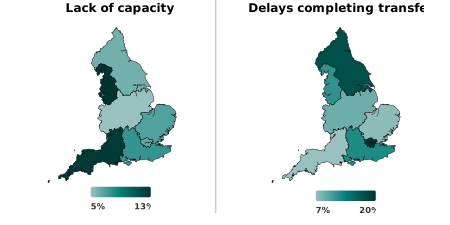
Most of these delays were due to a lack of suitable places in care homes, accounting for 8% of delayed discharges nationally. The North West and South West areas of England had the most hospital discharge delays due to a lack of available care home beds (both at 13%) (figure 16). Notably, the South West has the second lowest (after London) number of care home beds per 100,000 people aged 65 and over, and the number of beds per older population has fallen there by 13% over the last 7 years.
Figure 16: Care home capacity is a bigger barrier to hospital discharge in the North West and South West, while delays completing transfers to social care are more common in London
Proportion of delayed hospital discharges of people who had been in hospital for 14 days or longer (2025/26) by cause
Source: NHS England, Acute discharge situation report
Another 12% of delayed discharges in 2025/26, for people who had been in hospital for 14 days or longer, were because transfer arrangements between hospitals and social care services were still being negotiated. This is equivalent to delays for an average of nearly 1,100 people each day. The inefficient system working between hospitals and social care services was most prevalent in London, where 1 in 5 delayed hospital discharges (20%) in the year were because of delays in completing transfers between hospitals and social care services, the majority of which (13%) related to the interface between hospitals and care homes (figure 16).
In our Learning from Independent Care (Education) and Treatment Reviews in 2024 and 2025 report, we identified that poor discharge planning and a lack of joined-up system working were also exacerbating delays in discharging autistic people and people with a learning disability from mental health hospitals into community-based care.
Understanding and working to break down the barriers to hospital discharge for these groups of people is a key area of focus for us as we continue to lead on the programme of IC(E)TRs over the next 2 years. We discuss the programme and impact on people in the Focus on restrictive practices section of this report.
System partnership and collaboration
Despite the impact of poor transfer arrangements between hospitals and adult social care, we have seen examples of good partnership working between adult social care and the wider health and care system.
We undertook an analysis of our assessment data for adult social care services assessed under our current assessment framework since January 2024, looking specifically at the quality statements under the well-led key question. We found that services were performing well in 84% of assessments that looked at the partnerships and communities quality statement. This quality statement checks whether services understand their duty to collaborate and work in partnership, and that they share information and learning to promote improvement and joined-up care.
Example of partnership and collaboration in an outstanding care home
The provider clearly understood and fulfilled its duty to collaborate effectively, working in partnership with others to ensure services operated seamlessly for people. Information and learning were consistently shared with partners to drive improvement, and collaboration was embedded across all areas of practice to enhance outcomes for people.
Partnership working with health and social care professionals was a clear strength. External professionals consistently described collaborative, outcome‑focused relationships, with the service working routinely alongside GPs, district nurses, therapists and specialist teams. Professionals reported that leaders were receptive to feedback, responsive during quality visits and proactive in acting on recommendations, ensuring people received safe, well‑coordinated and joined‑up care. People were supported to remain connected to their community through strong links to local schools, faith groups, community organisations and events that promoted inclusion and reduced social isolation.
These partnerships ensured people experienced continuity of care, strong community belonging and opportunities to live full, connected lives, underpinned by a rights-based, partnership driven approach that consistently enhanced their wellbeing and quality of life.
The provider also maintained strong commissioning and system‑level relationships. Local authority commissioners described a positive and proactive partnership, highlighting the service’s willingness to innovate, engage constructively and sustain high standards in a challenging care market.
(From a CQC inspection report)
The emerging themes and findings from our assessments of local authorities in England with adult social care responsibilities showed how local authorities are playing an active leadership role across systems. Our report (see below) highlighted the importance of the quality of partnerships in an area, and how some people will be experiencing the positive benefits of living in a place where the voice of adult social care is respected and understood. Through these assessments, we found that the partnerships and communities quality statement had the highest combined percentage of local authorities that were scored at a good (74%) and exceptional standard (7%).
Local authority baseline assessments – 2024 to 2026
In July this year, we published our report, Local authority assessments 2023 to 2026: Emerging themes and findings, which drew together findings from the first-ever national programme of assessments of the performance of local authorities in England with adult social care responsibilities. The programme, which began in December 2023, assessed how local authorities are delivering their adult social care duties under Part 1 of the Care Act (2014). The report provides the most comprehensive picture of how local authorities are managing the needs of people who use adult social care services across England.
Since publishing the report in July 2026, we have updated the figures. As at the end of August 2026, based on the 152 assessment reports published, we found that local authorities are broadly performing well in the face of significant challenges, with:
- 59% rated as good
- 37% rated as requires improvement
- 3% rated as outstanding
- 2% rated as inadequate.
Although the majority of local authorities were rated as good, there were still areas that needed to improve, which caused most ratings to be at the lower end of the scoring threshold for good, suggesting they are still relatively far away from being outstanding.
Over three-quarters of local authorities achieved the lower scores of 1 or 2 for how they assess people’s needs, mainly because of the delays experienced by people, including unpaid carers, in receiving an initial assessment and a timely review of their needs.
We also found there is no statistically significant relationship between the average Index of Multiple Deprivation scores for local authorities and their overall ratings. This means there is no clear link between the performance of a local authority in delivering its Care Act responsibilities and the level of deprivation.
We used our analysis and the experiences of inspectors throughout the baseline assessment activity to highlight a number of key themes throughout this report.
Prevention
Local authorities broadly understood the value of an effective and consistent preventative approach. Partnership working, particularly with voluntary, community, faith and social enterprise organisations, was key to this.
However, they were not always able to show how they were implementing this approach and the impact on people:
- There was limited evidence of how local authorities were using outcome tracking or population-level evaluation to monitor the impact of preventative activity.
- Gaps in the provision of enablement and reablement services have a significant impact on people’s outcomes, and mean that people are not always supported to regain or maintain their independence.
- Prevention of mental ill-health is far less developed than prevention for physical health.
- Poorly-designed prevention pathways risk widening inequality, particularly where they disproportionately exclude people who are least able to navigate services.
- Prevention is often framed in the context of hospital discharge within local authorities, rather than through proactive, community-based early intervention.
Safeguarding
Where there were effective partnership arrangements for safeguarding, local authorities were able to carry out enquiries promptly that were sensitive to individual needs, wishes and best interests.
Where we considered low waiting times to be credible and indicative of positive outcomes for people, the enabling factors included skilled decision making at the ‘front door’ (first point of contact), effective multidisciplinary working and clear escalation routes.
However, low waiting times did not automatically indicate quality. Where meeting the 28-day threshold for safeguarding enquiries was prioritised over thoroughness, the quality of investigations could be poor. This could lead to poorer outcomes for people.
We found systemic weaknesses in governance, oversight and assurance of safeguarding:
- While some people felt listened to and involved in the safeguarding process, this was not the case for everyone.
- There was variation in local authorities’ understanding of safeguarding concerns and whether a concern met the threshold for a section 42 enquiry.
- The effectiveness of multi-agency working varied, with issues around sharing information with partners on the outcomes of safeguarding referrals.
- Safeguarding Adult Reviews were not used enough as system assurance tools. Without greater consistency and external scrutiny, their ability to prevent recurrence remained limited.
Both the safeguarding and the assessing needs quality statements received the most number of lowest scores, with 8 local authorities (5%) scoring 1. Improvements are needed in how local authorities discharge their responsibilities for safeguarding under the Care Act (2014).
Transitions from children’s to adult services
Transitions from children’s to adult services were consistently identified as one of the most challenging areas and a persistent area of risk. This meant people’s experience and the quality of care varied across, and even within, local authorities.
The National Institute for Health and Care Excellence quality standard (QS140) states that planning for transition should start by school year 9 (age 13 to 14). While some local authorities achieved this goal, in others planning did not start at the recommended age.
Poor transition planning has a negative impact on young people and their families. It can also be a safeguarding risk, with the lack of early contact and unclear accountability contributing to crisis-driven referrals and poorer outcomes for young adults and their families.
Clear communication and ensuring that young people and their families and carers knew what to expect when moving out of child services was essential to a successful transition. This involved supporting families through the process of moving from a focus on the ability of a young person’s family to provide care, to supporting a young adult to be independent. However, communications about transitions varied, with young people and families raising concerns about the quality of communication.
The transition process ran more smoothly when local authority teams worked well together – both within the local authority and with their partners. However, many inspectors described children’s services and adult services working in isolation, with unclear lines of responsibility and limited shared ownership.
Unpaid carers
Unpaid carers are less satisfied with the services and support they receive than the wider cohort of people using services.
Our report highlighted identification of carers as the biggest challenge, as well as inconsistent access to support, with language seen as a significant barrier. Terms such as “hidden carer”, “respite”, and “eligible needs” were described as masking risk, normalising burnout and implicitly placing responsibility on individuals rather than on systems. Many carers do not recognise themselves within the language used by the system, because they are not paid or they may feel that it is their ‘duty’ to care for their family member. Partnerships with the voluntary and community sector are a vital way of identifying carers.
Access to assessments for carers varied, and carers often described long delays, with some not being offered an assessment at all, and feeling “forgotten about”.
Some unpaid carers valued when their local authority tailored its approach to support their needs. However, some local authorities failed to assess and monitor carers’ individual needs, and there was an enduring cultural tendency to view carers “as extensions of the person receiving care and support”, rather than individuals who have needs of their own.
A personal story – experiences of family carers
As Sylvia's Alzheimer’s disease progressed, her sister Alison and her family were left to carry an increasing amount of responsibility because support was delayed, inconsistent, or unavailable. After a long wait, the family secured support from a homecare company, but concerns about the quality of care and communication led them to “lose faith” in the service.
Sylvia needed 24-hour care. Although a residential place was found, it proved unable to manage her complex needs and so her family chose to take on her care, keeping her in her own home – somewhere familiar to her. Most of her care was provided by her daughter, Catherine, who left her job to take care of her mum. She was supported by her siblings and Alison, all of them taking time away from work, family life and their free leisure time, to help. The family did their best to navigate the physical and emotional toll on them all of caring for Sylvia day and night, but stresses started to creep in. Catherine bore the brunt of this as she was more isolated as the primary carer, navigating increasingly unpredictable routines and sleepless nights as Sylvia woke many times each night. Although Sylvia eventually received a comprehensive package of care, the family continue to provide most of Sylvia’s care.
In addition to caring, Alison took on the role of managing Sylvia’s care package and budget. Each month she reviews and submits care workers’ timesheets, processes invoices from care companies, liaises with social workers and care companies, and challenges poor practice to ensure that Sylvia receives the best possible care. This also includes co-ordinating the family’s time to ensure that Sylvia is always cared for, balanced with legislative requirements for time off and holidays. Alison interviewed each personal assistant herself in a small, personally developed induction, introduced them to Sylvia and the wider family, explained Sylvia's likes and dislikes, and shared techniques for helping her when she became anxious.
Alison and Catherine have had to learn to use the electronic record system that the care workers use to update district nurses on any relevant work that the service has carried out and vice versa.
Alison described managing Sylvia's care as "like having a little company". Alongside travelling considerable distances to support her sister several times a week, she acts as the main source of knowledge and co-ordination for the family and professionals involved in Sylvia's care.
(Interview with a member of the public)
Equity in experience and outcomes
We found strong intent around equality, diversity and inclusion within local authorities, but weaker evidence of strategic action or measurable impact. Local authorities that were managing equalities well understood their communities and had well-resourced co-produced strategies and action plans on how they could tackle inequality. However:
- Data was not consistently used in an evidence-based way to tackle risks and inequalities or improve performance and outcomes for people.
- There was often a failure to use the knowledge of people whose voices are seldom heard and people with intersecting needs to drive effective commissioning to reduce inequalities.
- Local authority staff involved in carrying out Care Act duties had varied levels of understanding about people’s needs.
There was not always equality of provision and access to care and support. We saw disparities in waiting times and access to support for people with a learning disability, autistic people, people with complex mental health needs and people with sensory needs. These were often accepted as operational realities rather than recognised as equity issues.
Co-production
Co‑production was most effective:
- where it is embedded and aligned with decision-making, leading to clear and measurable improvements
- where leadership, commissioning and funding decisions in local authorities were driven by input from people with lived experience.
Partnerships with voluntary, community, faith and social enterprise organisations supported more effective co-production, particularly in reaching groups whose voices are seldom heard.
Commissioning
We found significant variation in commissioning practice across England.
- Inconsistent fee‑setting, failure to account for workforce pressures and weak provider engagement directly constrains quality and sustainability, particularly in carers’ and preventative services.
- We found wide variation in the criteria to determine whether people were able to access services, shaped by financial or political considerations rather than people’s assessed need.
- Provision of specialist sensory services was often not commissioned locally or was fragmented across providers, resulting in people travelling significant distances for basic support, which resulted in inequalities.
After the quality statement on assessing needs, performance against the care provision quality statement, which assesses commissioning, was one of the 2 quality statements most likely to be scored the lower scores of 1 or 2.