Annual report and accounts 2023/2024
Downloads
Performance analysis
The performance analysis is a detailed explanation of our performance during 2023/24 and underpins the performance review with evidence.
Strategic priority: People and communities
Summary of our assessment and inspection activity in 2023/24
People are at the heart of our regulation. During 2023/24, we carried out over 6,230 assessments and inspections of health and social care services across all sectors. This compares with 10,356 inspections carried out in 2022/23. The 6,230 inspections and assessments were carried out across 5,880 unique health and social care organisations. Technical issues and challenges with our new regulatory platform, along with starting to implement a new assessment framework and moving to new ways of working, had a negative impact on the number of assessments and inspections we completed during 2023/24.
During the year, we transitioned to a new regulatory approach, and in November 2023, we began phased implementation of a new single assessment framework. From November 2023 to the end of March 2024, we completed 150 assessments using our new regulatory approach.
Our Experts by Experience programme involves the public in our inspections and other regulatory activities. Experts by Experience are people who have recent personal experience of using, or caring for a person who uses, health, mental health, and/or social care services that we regulate. During inspections, we use input from Experts by Experience to support our judgements. They may observe how a service is delivered and speak with staff and people using services and their families or organisations that support them. During 2023/24, we used Experts by Experience in our inspection activity on 2,730 occasions (compared with 4,100 occasions during 2022/23).
We also involve specialist professional advisors in our work. They are health and social care professionals who contribute knowledge and expertise to our assessments and inspections. During the year, specialist professional advisors contributed to over 2,800 inspections (compared with approximately 4,130 in 2022/23).
Assessing implementation of the Patient and Carer Race Equality Framework
In October 2023, NHS England launched its first ever anti-racism framework: the Patient and carer race equality framework (PCREF), which all NHS-funded mental health trusts and mental health services are required to implement. We consider the PCREF to be an incredibly important part of advancing rights – as highlighted in our blog posts:
- Tackling inequalities in health and care — the NHS Patient and Carer Race Equality Framework
- Progressing the Patient and Carer Race Equality Framework — Improving mental health care for racialised communities.
During 2023/24, we started to develop guidance on incorporating the framework into our regulatory approach to assessments and inspections. In March 2024, we published our interim regulatory approach to look at how providers implement the PCREF. In our assessments, we will initially explore awareness of the framework, as well as providers’ arrangements and plans to develop and implement it in their organisations. Where possible, we also want to share learning about the practical development of the framework in trusts.
Assessing implementation of Martha’s Rule
We are committed to ensuring people receive the highest standards of care. In 2024, we published a joint statement with the Nursing and Midwifery Council and the General Medical Council on our support for NHS England’s implementation of Martha's Rule. This reinforces the fundamental principles of listening to people who use health and care services and their families and acting on what they say. Actively involving people in care decisions and addressing their concerns promptly is critical to safety. Martha’s Rule supports person-centred care that is responsive, and aligned with high standards of professional practice.
In 2024/25, NHS England began work to test and roll out Martha’s Rule in 143 hospital sites. We will work with professionals, the people they care for and their families and carers, to ensure the successful implementation and oversight of Martha's Rule.
Supporting people using maternity services
National review of maternity services in England
During 2023/24, we completed our programme of focused inspections of maternity services in NHS acute hospitals. Finishing in December 2023, we completed inspections of 92 NHS acute hospital maternity services (across 131 locations) that had not been inspected and rated since before April 2021, focusing on the safe and well-led key questions. During the programme, we engaged with women and people who use maternity services and the maternity workforce to capture their views and experiences and enhance our view of safety cultures in maternity services.
Our published programme report National review of maternity services in England 2022 to 2024 sets out our key findings, evidence of good practice, and common areas of concern. Having completed the inspection programme, we are now in a unique position to oversee the quality and safety of all maternity services in England. Alongside the report, we worked with providers, maternity staff, and stakeholder organisations to develop additional resource materials. These resources are aimed at maternity service staff at all levels to support efforts to deliver high-quality care and make improvements where needed.
Our commitment to improving outcomes in maternity services continues beyond this programme, as we also make recommendations for NHS trusts, the wider system, and national bodies. Findings from our programme will help shape our future approach to inspecting, analysing, and supporting safety culture in maternity services.
Supporting autistic people and people with a learning disability who use services
Independent Care (Education) and Treatment Reviews programme
The IC(E)TRs programme was set up in 2019 following a recommendation in our publication Out of sight -who cares?: Restraint, segregation and seclusion review. The reviews aim to reduce the use of long-term segregation for people with a learning disability and autistic people.
Following the publication of a final programme report by Baroness Hollins in November 2023, the Department of Health and Social Care asked us to lead on reviews for all autistic people and people with a learning disability who are in long-term segregation for the next 2 years.
In November 2023, we started to develop our joint working arrangements with NHS England, and worked to finalise our methodology, quality, and governance processes.
Policy position on reducing restrictive practice
Restrictive practice is making someone do something they do not want to do or stopping them from doing something they want to do, either by restricting or restraining them, or depriving them of their liberty. In August 2023, we published our cross-sector policy position on reducing restrictive practice. This outlines how we expect leaders of services, systems, and all those working in health and social care to take immediate steps to identify and reduce restrictive practices in their services, where possible.
Learning and reflections from the Supported Living Improvement Coalition
Good community-based options are critical to making sure people receive the right care and support where they live. The Supported Living Improvement Coalition involved different stakeholders that worked together to understand and improve supported living services.
During 2023/24, we evaluated our role in the coalition and reviewed the factors that are important for the quality of people’s experience in supported living. We published a series of blog posts that discuss these in more detail:
- Continuing the work of the Supported Living Improvement Coalition
- Factors affecting quality in supported living: a variable picture
- Factors impacting quality in supported living: choice, independence, equality
Assessing the implementation of statutory provider training on learning disability and autism
The Health and Care Act 2022 introduced a statutory requirement for providers to ensure their staff receive training in learning disability and autism that is appropriate to their role. The Oliver McGowan mandatory training is the standardised training developed for this purpose. It aims to save lives by ensuring health and social care workers have the right skills and knowledge to provide safe, compassionate, and informed care to autistic people and people with a learning disability.
During 2023/24, we updated our assessment approach to ensure that providers are competent to deliver care and treatment to all people using services, including those with a learning disability and autistic people. Our main focus is on whether services and staff are delivering safe, person-centred care, and treatment that safeguards people using services from abuse and improper treatment.
Supporting people using mental health services
Reducing harm from ligatures
In November 2023, we published guidance for providers on reducing harm from ligatures in mental health wards and wards for people with a learning disability. This focuses on removing or reducing the risk of patients taking their own lives or harming themselves using a ligature, particularly in combination with an anchor point.
The guidance emphasises therapeutic engagement and the practices it covers have wider benefits for patients and staff. We developed the guidance in collaboration with members of the Mental Health and Learning Disability Nurse Directors Forum and Experts by Experience. As part of the guidance, we've designed the ligature point recording template, which supports staff to identify and record ligature risk points. The template was developed with support from 40 different mental health and learning disability trusts, including private sector organisations, along with Experts by Experience, and people who use services.
Observing the culture in mental health services
During 2023/24, our regulatory approach had a greater focus on observing, understanding, and improving cultures in mental health services. Observations of care are a critical part of our inspections. Our blog post summarises how we’re getting beneath the culture in high-risk mental health services. During this period, 192 of our assessments and inspections were inspecting a mental health service facility.
We continued to implement our use of the short observational framework for inspection tool. This is designed to help us capture the experience of any person who may have cognitive or communication impairments, or for people who might not be able to communicate their experiences for other reasons such as fear, institutionalisation, or coercive control. We continue to build our evidence base, test current risk assumptions, and enhance structured observation skills among inspection staff, so we can proactively address signs of a developing closed culture before people face actual, or significant risk of, harm, abuse, neglect, or discrimination.
Gathering people’s experiences of using health and social care services
Public engagement strategy 2023 to 2026
In June 2023, we published our public engagement strategy 2023 to 2026, where we outline our ambitions and strategy for engaging with people who use services, their families and unpaid carers, and organisations that represent them or act on their behalf. Our new public engagement strategy has 4 overarching objectives:
- Build a trusted feedback service where people’s experiences drive improvements in care.
- Create a trusted, accessible information service that meets people’s needs.
- Develop an inclusive approach to involving people who use services, their families, carers, and organisations that represent or act on their behalf, in shaping our plans, policies, and products.
- Work in partnership with organisations that represent or act on behalf of people who use services in our collective endeavour to improve care.
Share for Better Care public awareness campaign
Everyone can play a part in improving care by giving feedback on services. During 2023/24, we worked with Healthwatch England, the Race Equality Foundation, the National Dignity Council, and the Royal Association for Deaf People to develop a public awareness campaign around gathering feedback from people’s experiences of care services.
Our Share for Better Care campaign builds on the success of our previous campaign, Because We All Care, and aims to increase the range and volume of care experiences that people choose to share with us. We’ve developed a campaign toolkit full of materials for organisations and charities to use, to help promote the benefits of giving feedback on care experiences.
The Share for Better Care campaign centres around research and audience insight, and focuses on engaging people whose voices are seldom heard, especially people from ethnic minority communities, autistic people and people with a learning disability, disabled people with physical or sensory impairments, and people in lower-income groups.
We received over 81,100 submissions of feedback on care, compared with over 96,300 in 2022/23 and 64,600 in 2021/22. We use people's feedback to help health and social care services make improvements. During 2023/24, people’s feedback and experiences directly initiated over 1,059 of our assessments and inspections.
We continue to monitor the benefits and impact of our activity through surveys about the views and awareness of the public, stakeholders, and providers. We carried out our annual provider survey in September 2023. Over 12,300 providers responded (a response rate of 25.6%), and over 85% of respondents agreed that we focus on what matters most to people who use services throughout our regulatory activities.
Strategic priority: Smarter regulation
Our new regulatory approach
Aiming to deliver the ambitions in our strategy, we developed and implemented a new regulatory approach to provide further benefits for the public and those we regulate. During 2023/24, we started to implement the following activities.
Single assessment framework
We started to implement a new framework to help us assess and inspect the health and social care providers we regulate in England, and to provide a vision of the quality of the whole health and care system. The assessment framework applies to providers and local authorities (and ICSs when appropriate).
We developed the single assessment framework over 3 years following co-production and consultation with a range of people. This included people who use services and the people who care for them to ensure our framework represents and supports them and their needs. We worked closely with Think Local Act Personal to embed people’s expectations about what they want from good health and social care into how we assess quality. We also worked closely with thousands of providers across the sectors we regulate to ensure a good understanding of the changes being introduced and what it would mean for them.
We published guidance on the new approach and started to implement the single assessment framework in November 2023. By March 2024 we were using it for all our assessments. Our 5 key questions and our ratings (outstanding, good, requires improvement, and inadequate) are still central to our approach. The framework assesses services against quality statements, with evidence grouped in 6 categories gathered both on site and off site. However, there were challenges in implementing our new assessment approach, which mean we needed to rethink our ways of working.
New provider portal
We developed a new provider portal, aiming to make it easier for providers to share information with us, and to connect the data and insight we receive from people using health and care services, providers, and partners, along with the information we gather from our own assessments of services. The new provider portal was launched in March 2024 and approximately 8,000 providers created an account. The functionality was intended to provide the ability to submit new registration applications, cancel or change existing registrations, and submit certain types of statutory notifications to us when needed.
However, there were challenges in implementing the new provider portal, as technical issues meant some providers experienced delays in registering with us and not all providers could use the functionality. We continue to improve functionality of the new provider portal and aim to bring a faster and improved experience when providers interact with us. This is further described in the Governance Statement.
Updated enforcement policy and action taken
We have a wide set of enforcement powers that allow us to protect the public and hold registered providers and managers to account. We are the primary enforcement body at a national level in England for ensuring that people using health and adult social care services receive safe services of the right quality.
In November 2023, we updated our enforcement policy to align with our new regulatory approach. The policy explains our approach to taking action where we identify poor care, or where registered providers and managers do not meet the standards required in the regulations.
During 2023/24, we took enforcement action against registered persons where the quality of the care they are responsible for fell below what is legally required, and to make sure they improved. During this period, we:
- issued 932 Warning Notices
- served a total of 2,216 notices (including Notices of Proposal and Notices of Decision)
- undertook 128 urgent enforcements
- cancelled 152 provider registrations.
From our inspection activity in 2023/24:
- approximately 2.3% of inspections resulted in us taking civil enforcement
- 6% led to us issuing a Warning Notice
- 20.4% led to us issuing a Requirement Notice.
Updated human rights approach
Ensuring people who use health and care services have their fundamental rights respected and upheld is a priority for us as regulator, for providers and commissioners, and, of course for staff when it comes to delivering care. When people tell us about what is important in their care, issues of human rights feature strongly – such as dignity, respect, and fairness.
In December 2023, we published our updated our human rights approach, which enables us to focus more on human rights in our new regulatory approach and to respond to challenges of recent years. When delivering care, practices that respect human rights are fundamental to good outcomes for people. Staff, providers, and commissioners can therefore choose to improve quality by delivering human rights-based care. In our 2023 annual provider survey, 89% of respondents agreed that we are effective in ensuring people have their human rights upheld while using the service.
Assessing local authorities and integrated care systems
The Health and Care Act 2022 gave us new responsibilities from April 2023, enabling us to provide a meaningful and independent additional assessment of care in a local area. This includes assessing the performance of local authorities in meeting their duties under Part 1 of the Care Act 2014 and assessing whether ICSs are meeting the needs of their local populations.
Local authorities
In summer 2023, we tested our regulatory approach and processes while carrying out pilot assessments of 5 local authorities. Following an evaluation of our pilot assessments, we reviewed and updated some aspects of our approach and, following government approval, we published our updated guidance for local authorities in December 2023.
We began formal local authority assessments in December 2023 and completed 3 formal local authority assessments by the end of March 2024. We plan for our initial formal assessment period to last 24 months. Within this 2-year period, we aim to gather evidence from all 153 local authorities so that we can complete initial assessments, award ratings, and report on our findings. We aim to report on what we find locally and nationally, which includes:
- documenting the challenges, risks and impact on local populations
- supporting improvement by highlighting best practice and any innovative ways that systems are providing care and support to local people
- using our evidence and independent voice to inform and influence wider system reforms.
Integrated care systems
In July 2023, we carried out pilot assessments of 2 integrated care systems (ICSs) that volunteered to participate: Birmingham and Solihull Integrated Care System and Dorset Integrated Care System. This was to test our approach and assessment framework. We published assessment reports following on-site and off-site assessment activities. We further developed and revised our assessment methodology and reporting approach, which will only commence officially when we receive government approval.
Our regulatory approach was informed by research and evidence commissioned during 2023/24 from our research partner RSM UK Consulting LLP, including:
- Effective systems of health and care: an evidence-based understanding of characteristics of effective systems of health and social care.
- Findings from a literature review on health inequalities within a local area. We also explored how those responsible at an ICS level are supporting and meeting the needs of people who might not have equal access, experience, or outcomes from health care. We used this evidence to consider how local systems can reduce health inequalities, and used the findings to inform our assessment methodology.
In autumn 2023, we held a public consultation about how we recover our regulatory costs for assessing ICSs. The consultation outcome sets out our intended short-term approach of charging integrated care boards (ICBs) an annual regulatory fee. Following government approval, we will publish an updated fees scheme ahead of assessing ICSs.
Special review into Nottinghamshire Healthcare NHS Foundation Trust
In January 2024, the Secretary of State for Health and Social Care commissioned us to carry out a rapid review of Nottinghamshire Healthcare NHS Foundation Trust under Section 48 of the Health and Social Care Act 2008. This was to determine whether the available and relevant evidence indicates wider patient safety concerns or systemic issues with the provision of mental health services in Nottinghamshire.
In March 2024, we published the first part of our review: an assessment of patient safety and the quality of care at Nottinghamshire Healthcare NHS Foundation Trust, and progress at Rampton Hospital since our last inspection in July 2023. Our review reflects insights from on-site visits, feedback from people who use services, and data including surveys and prevention reports. We also consider the past 5 years of our inspections and broader oversight of mental health services.
Guidance for providers for visiting and accompanying rights
Enabling visiting is crucial to the health and wellbeing of those receiving care. It ensures that people remain connected with loved ones and their community and have people to support, and advocate for, them when they are at their most vulnerable. In December 2023, the Department of Health and Social Care announced legislation to make visiting and accompanying a fundamental standard of care, see Regulation 9A: Visiting and accompanying in care homes, hospitals and hospices.
Ahead of the new fundamental standard coming into effect in early April 2024, we publicly consulted on our guidance for visiting and accompanying in care homes, hospitals and hospices. The guidance helps providers and other stakeholders to understand and meet the new fundamental standard and their new roles and responsibilities. It also sets out what people using health and social care services and their families, friends, and advocates can expect.
Our published annual reports
During 2023/24 we published the following annual reports, most of which are statutory reports required by legislation:
Monitoring the Mental Health Act in 2022/23
Published in March 2024, this report summarises our findings from the 860 monitoring visits related to the Mental Health Act that we completed in 2023/24. It also details our interactions and insights from engaging with people subject to the Mental Health Act, along with our assessment of registered services providing care and treatment to them.
The report captures examples of good practice, with staff doing their best in difficult circumstances to provide people with safe and effective care. However, our findings show that short staffing and underfunding result in children and young people with mental health needs facing long waits for essential treatment. Our findings also show that racial inequalities in care persist.
Under the Mental Health Act, we have a statutory duty to administer a second opinion function as a safeguard for patients whose rights are restricted under the Act. Although we administer the process, we are independent and not involved in clinical decisions within second opinions. When we receive a request for a second opinion, we arrange for a suitable doctor to visit the patient, organise the bidding for a doctor, and track the outcome. In 2023/24, we arranged 15,794 second opinion appointed doctor (SOAD) visits to patients. Once the SOAD was appointed, the visit took place on average in just over 4 days (4.2 days). This compares with approximately 11,300 SOAD visits taking place in just under 3.5 days in 2022/23.
Other reports published during the year include:
State of health care and adult social care in England 2022/23
In October 2023 we published the State of Care 2022/23. State of Care is our annual assessment of health care and social care in England. We use everything we know about services from all our activity as a regulator to tell the story of services from the perspective of people using them. The report looks at the trends, shares examples of good and outstanding care, and highlights where care needs to improve.
The report captures our concerns around access to care and the workforce challenges across all sectors, both of which are being exacerbated by the cost of living crisis and ongoing industrial action. It highlights how there is a backlog of care with record numbers of patients on waiting lists for treatment. It also includes our continued concerns around the quality of care, particularly in maternity services, and in services for autistic people and people with a learning disability.
Ionising Radiation (Medical Exposure) Regulations annual report 2022/23
This reports on our work under the Ionising Radiation (Medical Exposure) Regulations 2017 during 2022/23. The report provides a breakdown of the number and types of notifications we received about IR(ME)R incidents between 1 April 2022 to 31 March 2023, and findings from our 31 inspections. We also share learning from examples of errors and the actions that providers took to improve.
Annual report and accounts 2022/23
Following relevant governance and external audit, we published our Annual report and accounts 2022/23. This publication is a statutory requirement for all public sector bodies.
The safer management of controlled drugs: annual update 2022
We are responsible for making sure that service providers and other regulators maintain a safe environment for the management and use of controlled drugs in England. We do this under the Controlled Drugs (Supervision of Management and Use) Regulations 2013. Our annual report on the safer use of controlled drugs highlights our regulatory oversight activities and inspection findings in 2022 and provides data and analysis of national trends in the prescribing of controlled drugs .
Defence Medical Services: annual report for 2022/23 (Year 6)
The sets out what we found in our inspection programme from 32 inspections of the quality of care in Defence Medical Services in Year 6 of the programme. The Defence Medical Services Regulator has continued to commission us to inspect health care and medical operational capabilities. The programme of inspections started in 2017/18.
Registering new providers
During 2023/24, we updated our registration process to align with our new regulatory approach and new technology. We aim to provide more clarity and support to providers through streamlined processes and updated guidance. As part of our registration process, we ensure we only register people who we judge to be ‘fit’ and who we consider likely to provide and manage good quality care that meets people’s needs. The term ‘fitness’, the regulated activities, and wider registration requirements are set out in the Health and Social Care Act 2008 and its associated regulations.
In total, we processed over 33,700 registration applications during 2023/24. These new registrations increase capacity in health and social care services, and ensure more people have access to them. During 2022/23 we processed over 35,600 provider registrations (including creating new ones and amending existing ones).
Strategic Priority: Safety through learning
How we handle information of concern
We receive ‘information of concern’ from a range of different sources, including from workers speaking up from within health and social care, people who use services and their families or unpaid carers, stakeholders and the public. We have a responsibility to handle and respond to information about any service we regulate. Our National Customer Service Centre processes the information in concerns we receive.
When information of concern indicates that a person, or people, might be at risk of significant abuse or neglect, it is defined as ‘safeguarding’. Local authorities lead on investigating safeguarding concerns under the Care Act 2014. If we are the first agency to receive safeguarding information, we make a referral to the local authority.
We do not have powers under the Health and Social Care Act 2008 to directly investigate complaints from people, or concerns from workers speaking up, including whistleblowing. However, we do have the power to investigate complaints about the use of the Mental Health Act, specifically those that relate to a person who is (or has been) detained in hospital under the Mental Health Act, or is subject to guardianship or a community treatment order.
When we receive any information of concern, we first consider our regulatory role and our most appropriate regulatory response. For example, we may either:
- request further information or assurance from a provider
- decide to carry out an assessment
- contact the local authority or police.
We also use information we receive to monitor and assess whether a service is meeting the fundamental standards of quality and safety. Where necessary, we take regulatory action to require a service to improve.
Improving how we handle information of concern
During 2023/24, we reviewed our approach to handling information of concern that we receive and how we respond.
To improve our policies and procedures, we:
- Implemented an end-to-end standard operating procedure for handling information of concern, to support colleagues with decision-making and consistent recording.
- Clarified our governance processes for information of concern, providing oversight of the end-to-end process.
- Updated our safeguarding policy to align with our new regulatory approach.
- Refreshed guidance for colleagues on how to handle and respond to concerns we receive from workers speaking up, for example, people employed by a provider registered with us.
To improve our organisational capability for safeguarding, we:
- Developed bespoke safeguarding training from level 1 to level 3, targeted at supporting colleagues in fulfilling our regulatory role. Level 3 training takes place in person and is a mandatory requirement for all colleagues handling information of concern or carrying out assessments.
- Established a specialist safeguarding and closed cultures team that provides subject matter expertise and support to colleagues in CQC. The specialist team also supports with complex work and developing improvements to our approach.
- Established safeguarding performance coaches to support colleagues in handling information of concern and to provide coaching support.
To improve our assurance, we developed and piloted assurance processes to enable internal auditing and routine quality checking of our information of concern records and regulatory response.
To improve our reporting, we:
- Published a Prescribed persons report 2023/24, to support with transparency in the way we deal with whistleblowing disclosures.
- Continue to report further detail about the information of concern we receive, including safeguarding concerns and concerns from workers speaking up to us, in our Annual report and accounts publication.
Information of concern – regulatory activity
During 2023/24, we received and processed over 195,400 information of concern cases. Of these, over 30,300 were safeguarding cases and over 20,900 were from workers speaking up to us.
Of the 30,300 safeguarding cases we received, we categorised 4,700 as safeguarding ‘priority 1’. Priority 1 cases indicate that people using services have experienced, and are at continuing risk of, significant abuse or neglect and we are the first statutory agency to receive the information. When we receive priority 1 cases, our first regulatory action is to make a safeguarding referral to the relevant local authority. During 2023/24, we made 78% of safeguarding referrals to the relevant local authority within 1 day of receiving the information (compared with 97% during 2022/23).
The remaining 25,500 safeguarding cases received were categorised as ‘priority 2’. Priority 2 cases are safeguarding concerns where we consider the information indicates that people using services have experienced significant abuse or neglect, but this is not continuing, and people are no longer at risk, or the local authority is already aware of the risk. When we receive priority 2 cases, we use the information to inform our regulatory risk and take an appropriate regulatory response. For example, we may use the information to inform a current or future service assessment, decide to bring forward a planned assessment, or request specific information from providers.
During 2023/24 we received over 20,900 information of concern cases from workers speaking up to us. We know that whistleblowing has a specific meaning under the Public Interest Disclosure Act 1998. We are a prescribed person as identified from the Public Information Disclosure Act 1998. Therefore, when workers share information with us that meets the criteria for a qualifying disclosure it is a ‘protected disclosure’ and individuals are covered by whistleblowing law.
We received and processed 15,919 information of concern cases from workers raising protected disclosures with us (whistleblowers). As a prescribed person, we have statutory reporting requirements from the Prescribed Persons (Reports on Disclosures of Information) Regulations 2017. In our Prescribed persons report 2023/24, we provide further detail about how we processed and responded to protected disclosures from whistleblowers.
Organisational abuse and closed cultures – regulatory activity
We play an important role in the health and social care sector in identifying organisational abuse and closed cultures. Throughout 2023/24, we focused on strengthening our networks with external partners and collaborated in the development of an expert reference group for organisational abuse. We continue to work with Durham Safeguarding Adults Partnership following the Whorlton Hall Safeguarding Adults Review summit in early 2024. The summit reflected on the national issues from the review and highlighted the commitment needed from key agencies to result in system change.
Learning from research and evaluation to inform our regulatory activity
Since publishing our strategy in 2021, we have committed to investing in research and to embed a culture of learning and evaluation.
During 2023/24, we published our first research programme annual report for 2022/23, which captures our full range of research and evaluation activity during this period. Our research programme impact report 2023/24 shows how learning from our research provided evidence to support ongoing development of our regulatory approach.
For example, we commissioned The Healthcare Improvement Studies Institute (THIS Institute) at University of Cambridge, with RAND Europe to evaluateour national maternity inspection programme and to identify where we can improve. We have a clear role in outlining the quality of care that people should expect and holding services to account if they fail to meet these standards. Learning from this evaluation will help us carry out our role in the future.
National patient survey programme
We use survey findings as evidence to further our understanding of the risk and quality of services and those who organise care across an area. Where survey findings provide evidence of a change to the level of risk or quality in a service, provider or system, we will use the results alongside other sources of data from people’s experience to inform targeted assessment activities.
We completed and published the following survey findings as part of the national NHS patient survey programme:
- Community mental health survey 2024
- Maternity survey 2024
- Adult inpatient survey 2023
- Urgent and emergency care survey 2024
Learning from safety incidents
To support all services to have stronger safety and learning cultures, we continued to publish learning from safety incidents bulletins. The bulletins enable registered persons to learn from our recent prosecutions. Each bulletin describes a critical safety issue including what happened, what actions we and the provider took, and steps a provider can take to avoid a similar situation happening. Protecting people using wheelchairs is about the need for wheelchairs to be fit for purpose and risk-assessed to keep people safe. The bulletin contains learning from a situation where we prosecuted a care home provider for exposing a person using its service to a significant risk of avoidable harm that resulted in a life-changing injury.
Other research findings to inform our regulatory activity
We also undertook the following research to inform our regulatory activity and our new regulatory approach:
- Annual provider survey 2023: this captured over 12,000 responses from providers in areas relating to workforce supply, demand for services, and challenges affecting a provider’s ability to deliver good quality care and to improve.
- Strategy assurance indicators: this reviewed how regulatory and oversight organisations show evidence of the impact of their strategies and how this is monitored and communicated.
Strategic priority: Accelerating improvement
Developing our policy position on modern slavery and international recruitment
In November 2023, we published our regulatory policy position on modern slavery and unethical international recruitment (see also our blog post) and updated our statement on modern slavery and human trafficking.
We recognise that workers recruited from overseas are a hugely valuable and important part of the UK’s health and social care workforce. However, a nationwide shortage of staff across health and social care, along with changes to immigration visas, increases the risk of mistreatment of both the existing workforce and internationally recruited staff. This includes an increased risk of modern slavery and unethical international recruitment practices.
We do not have the powers to investigate concerns relating to modern slavery and unethical international recruitment practices directly, our website provides information about how to report modern slavery. We commit to working with other organisations at a national level to address the root causes of modern slavery, and to reduce the likelihood of modern slavery and unethical international recruitment practices in health and social care settings. These include the Home Office’s UK Visas and Immigration directorate, the Gangmasters and Labour Abuse Authority, and the Department of Health and Social Care.
We also share national information about risks to equality and human rights, including those associated with modern slavery, through our existing memorandum of understanding with the Equality and Human Rights Commission. During 2023/24 we made 108 referrals regarding modern slavery and exploitation.
We review information we receive against associated regulations in the Health and Social Care Act 2008, to assess for potential breaches of our regulations and to ascertain whether there are potential risks to the safety and welfare of those who use services.
We continue to undertake a programme of work to develop a systematic approach to managing and mitigating modern slavery and unethical international recruitment, and to provide robust assurance that we are addressing the issue and regulating effectively.
Focusing on innovation to accelerate improvement
To deliver the ambitions in our strategy we want to encourage and champion innovation and technology-enabled services. We want to create an environment where innovation can thrive, and where our regulation can keep pace with wider changes. Innovation has long been at the heart of health and social care, and must undoubtedly be part of how we meet the changing needs and growing pressures seen today. We recognise that more could be done to encourage and support innovation in health and social care and, importantly, that people and quality need to be at the heart of any innovation.
We have many reasons to promote and support innovation in health and social care:
- The system is struggling to meet demand, and innovation can create new ideas to address related challenges.
- New ideas and new technologies can provide opportunities to deliver better quality care, tackle inequalities, and improve outcomes.
- There is strong government support for innovation in health and care, with recognition of the potential benefits to the public, to the providers that we regulate, and to sustainable economic growth.
- According to our 2023 annual provider survey, just under three-quarters (73%) of respondents agree that we provide an environment where their service feels that it can innovate and try new ways to deliver safe care. However, fewer than a half (47%) of respondents agree our information supports their service's efforts to innovate or adopt innovations from elsewhere.
The Regulators’ Pioneer Fund (RPF) supports UK regulators and local authorities to adopt new and experimental regulatory approaches that seek to remove barriers to innovation, and helps businesses get their innovative products and services to market faster.
In September 2023, we published findings from our Capturing innovation to accelerate improvement project, funded by a grant of £118,000 from the RPF. This project involved working with people from across health and social care to understand the experiences of providers and innovators who have considered developing or adopting new ways of working. This included exploring the barriers they experienced to innovation.
We then looked to further understand how we could mitigate these barriers and how we can support innovation through our regulation. As part of the project, we published a new resource, Mapping the stages in an innovation, to support providers and innovators to develop new ways of working. We also published case studies capturing situations where providers have developed and implemented innovation.
During the year, we received a further grant of £222,200 from the RPF to undertake research into driving innovation and accelerating improvement in medicines sustainability. Medicines sustainability is about reducing environmental harms from medicines. The Health and Care Act 2022 places a duty on NHS England, NHS trusts and foundation trusts, and ICBs to contribute towards environmental targets. Medicines optimisation is a person-centred approach to ensuring people get the most benefit from their medicines.
This project includes developing a suite of products to support providers, local systems, and businesses to innovate in this space and directly shape our regulatory approach to medicines sustainability.
Focusing on research and evidence to accelerate improvement
In our 2023 annual provider survey, over three-quarters of respondents (78%) agreed that our major reports and publications stimulate a national conversation about safety in health and social care.
In September 2023 we updated our Patient FIRST support tool. Patient FIRST is designed by clinicians, for clinicians. It includes practical solutions for all emergency departments to consider. Implementing these solutions supports good, efficient, and safe patient care for both adult and paediatric care. It also includes guidance for senior leaders at trust and system levels. In the latest version, we’ve updated references to infection control procedures that changed since the height of the coronavirus (COVID-19) pandemic, as well as other minor references to the pandemic.
We received a further grant of £635,400 from the RPF in September 2023 to support ICSs in reducing health inequalities. We worked with National Voices and The Point of Care Foundation to develop a self-assessment and improvement framework. This aims to help ICSs improve how they engage with people and communities, using a whole-system approach to embedding meaningful engagement and reducing health inequalities in line with their people and community strategies.
We also commissioned our research partner, RSM UK Consulting LLP, to create an overview of the improvement support that is currently available across health and social care. Improvement support across sectors combines findings from a literature review, additional online searches, and insights from interviews and expert panel workshops.
We commissioned research into inequalities in dementia care and published the findings in December 2023. This explored why some people with dementia get better care than others, and the barriers that prevent people getting good care. The findings identify insights from existing literature and qualitative research to understand and address inequalities in care for people living with dementia in residential and nursing care settings.
As part of our commitment to person-centric care, we worked with the University of Bedfordshire to produce guidance for care home managers and the public on the availability and management of alcohol in care homes. The guidance focuses on both the benefits of having alcohol available to care home residents who want it, and how to mitigate potential risks.
Working with other organisations to drive improvement
Joint inspections with Ofsted
We carry out joint inspections with the Office for Standards in Education, Children's Services and Skills (Ofsted) at the request of the Secretary of State for Education under section 20(1)(a) of the Children Act 2004. Inspectors assess the extent to which local area partners are complying with relevant legal duties relating to arrangements for children and young people with special educational needs and disabilities. Relevant legal duties could include duties under the Children and Families Act 2014, the Equality Act 2010, and the Human Rights Act 1998.
In late 2022 we jointly launched a new inspection framework with Ofsted. The new framework has a greater focus on hearing directly from children and young people with special educational needs and disabilities, and their families. We began joint inspections under the new framework in January 2023. During 2023 we carried out 26 full inspections in local areas across England and published reports for the inspection activity.
Joint targeted area inspections
We continued to work with other organisations (Ofsted, His Majesty’s Inspectorate of Constabulary and His Majesty’s Inspectorate of Probation) to undertake joint targeted area inspections (JTAIs). These assess how local authorities, the police, health, probation, and youth offending services are working together in an area to identify, support, and protect vulnerable children and young people. The inspections allow inspectorates to be more responsive, targeting specific areas of interest and concern. They also identify areas for improvement and highlight good practice from which others can learn.
Findings from our JTAIs focusing on children and families were included in Ofsted’s thematic report, The multi-agency response to children and families who need help, which was published in November 2023.
We also contributed to Ofsted’s published guidance with a thematic focus on serious youth violence, as part of the JTAIs programme. The updated version was published in August 2023.
Digitising Social Care programme
The Department of Health and Social Care and NHS England lead the NHS Transformation Directorate’s Digitising Social Care programme.
The programme aims to encourage and support adult social care providers registered with CQC to adopt digital social care records. We support the programme and, in 2023, published guidance to reflect the developing best practice around digital record systems, particularly where it helps to improve the quality and safety of care.
Core ambition: Assessing local systems
Local authority assurance
We completed 3 formal local authority assessments by the end of March 2024. In summer 2023, we tested our regulatory approach and processes while undertaking pilot assessments of 5 local authorities. Following an evaluation of our pilot assessments, we reviewed and updated some aspects of our approach and, following government approval, we published our updated guidance for local authorities in December 2023.
Assessing integrated care systems
In 2023 we published interim guidance on our approach to assessing integrated care systems. We then tested our approach and processes by undertaking pilot assessments of 2 ICSs. Since publishing the reports, we further developed and revised our assessment methodology and reporting approach.
Core ambition: Tackling inequalities in health and care
Responses from our annual provider survey 2023 show that just under four-fifths (79%) of respondents agreed that we have a sufficient focus on reducing inequalities in health and social care. Over three-quarters of respondents (77%) also agreed that our major reports and publications effectively call out inequalities in health and social care.
The following is a summary of our regulatory activity during 2023/24 to tackle inequalities in health and social care.
We continued our focus on inequality and unfair care in our State of Care 2022/23 report and other national reports. This highlights the connection between equality and human rights and includes experiences of inequalities relating to harm in care by people in the following groups:
- people using mental health services
- people from ethnic minority groups
- pregnant women
- autistic people and people with a learning disability
- children and young people.
We launched projects to focus on gathering feedback from people more likely to have poor access, experience, or outcomes from care. This included local inequalities outreach pilots involving local engagement with people more likely to experience inequality.
We launched our Share for Better Care public awareness campaign with Healthwatch England. The campaign aims to encourage everyone to give feedback on their experiences of care and particularly focuses on engaging people whose voices are seldom heard, especially:
- people from ethnic minority communities
- autistic people and people with a learning disability
- disabled people with physical or sensory impairments
- people in lower-income groups.
We also launched targeted awareness campaigns and partnerships with community and voluntary sector organisations, driven by our new public engagement strategy. We launched an updated ‘Tell us about your care’ programme with national organisations that hear from, and are trusted by, people who are more likely to have a poorer experience of care. Our partners include Carers UK, Disability Rights UK, and the Patients Association. These charities support people to complete our give feedback on care forms, generating high-value feedback to us.
We included new equity quality statements in the single assessment framework as part of our new regulatory approach. We made an initial assessment of how ICSs are approaching their role in ensuring equal access to care. We piloted an assessment of equity in experience and outcomes in local authority assurance reviews and ICS assessment pilots.
Drawing on our memorandum of understanding, we strengthened how we share information (including press releases, inspection reports, how and when we make referrals, and wider thematic data) with the Equality and Human Rights Commission. . We also consider equality and human rights an area of strategic interest when reviewing our memoranda of understanding with other partner organisations.
We undertook research to deepen our understanding of the regulatory activity required to tackle inequalities, commissioning and publishing 2 research projects about key issues for regulating equality, health inequalities in local areas, and equality in adult social care services for people with dementia. We also commissioned research to learn how regulators in other sectors and countries tackle inequality. The findings will provide an evidence base for our next set of equality objectives.
We used our independent voice to highlight our expectations of providers on workforce equality by publishing a policy position on modern slavery and unethical international recruitment (November 2023). In our State of Care report 2022/23, we highlighted the experiences, challenges, and risks to staff working in health and social care providers, and the impact this has on care for people using services. We particularly highlighted experiences of midwives from Black and Asian communities and internationally recruited staff.
We demonstrated our commitment to advancing race equity in mental health for people from ethnic minority groups by incorporating NHS England's Patient and Carer Race Equality Framework into our regulatory approach. In March 2024, we published our interim approach to incorporating the framework into our assessments and inspections. The anti-racism framework supports mental health trusts and providers to offer more accessible and culturally responsive services.
We launched an RPF-funded project that aims to develop a framework to support ICSs to reduce health inequalities by improving how they engage with people and communities, and how they use the feedback to act on health inequalities. ICSs will be able to use the self-assessment framework to demonstrate their work in this area.
What we spent in 2023/24
From a total funding envelope of £294.4 million in 2023/24, we incurred total expenditure of £294 million across our funding sources, which we manage separately to ensure there is no cross-subsidisation to align with Managing Public Money:
| Fee income received and retained | Revenue Grant in Aid | Capital Grant in Aid | Contract income | Non-cash allocation | Total | |
|---|---|---|---|---|---|---|
| Funding | £233.3m | £34.1m | £22.7m | £3.1m | £1.2m | £294.4m |
| Expenditure | £231.6m | £35.7m | £22.4m | £3.1m | £1.2m | £294.0m |
Although we have invested in our transformational change portfolio over recent financial years, our pay and non-pay have seen little impact considering the significant level of inflationary pressures we have faced (shown with increasing revenue and capital spend over the period in figure 1). Figure 1 shows our expenditure profile by year from 2018/19 through to 2023/24.
Figure 1: CQC total expenditure profile since 2018/19
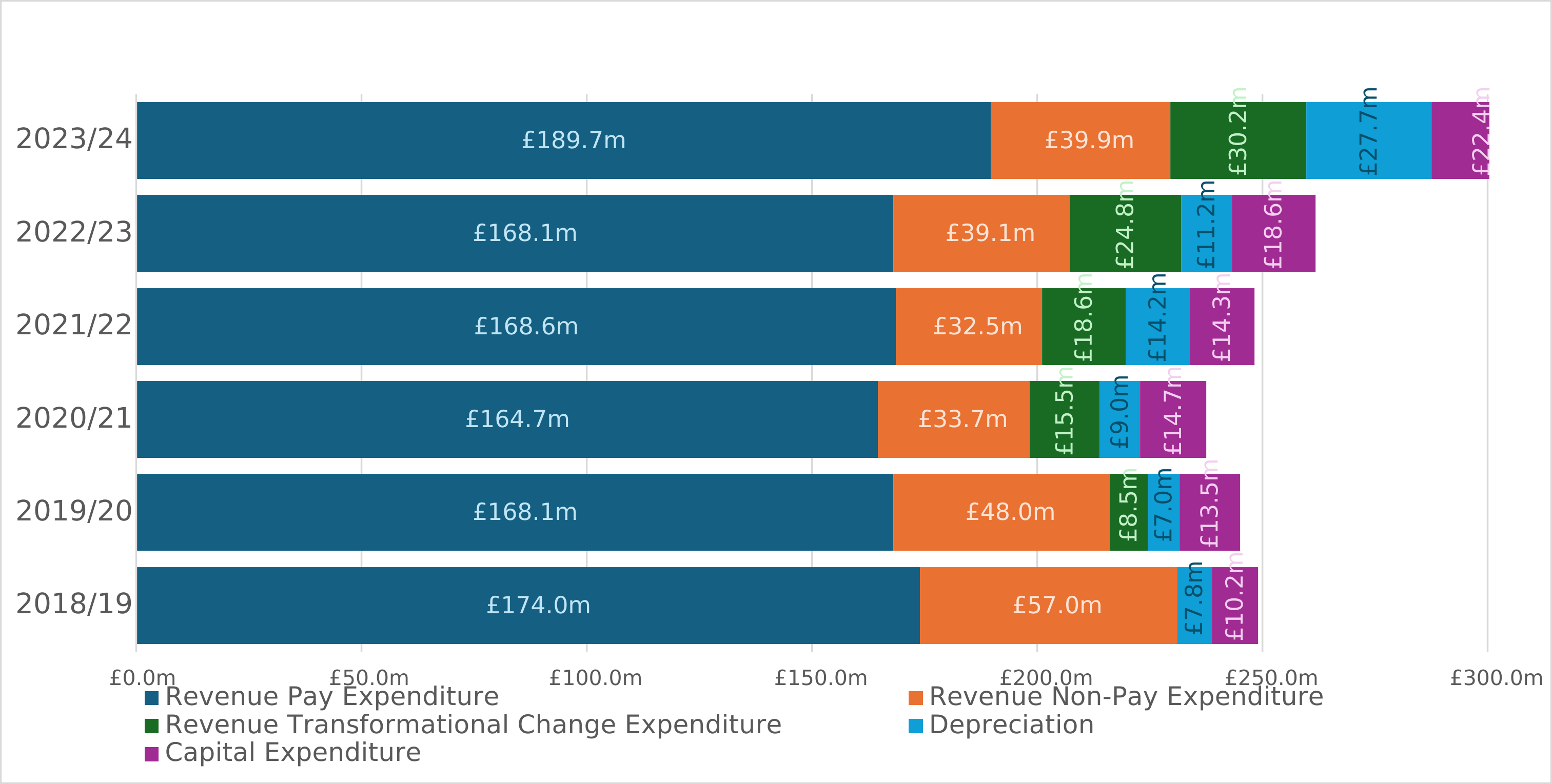
Figure 2: Revenue pay expenditure profile 2018/19 v 2023/24
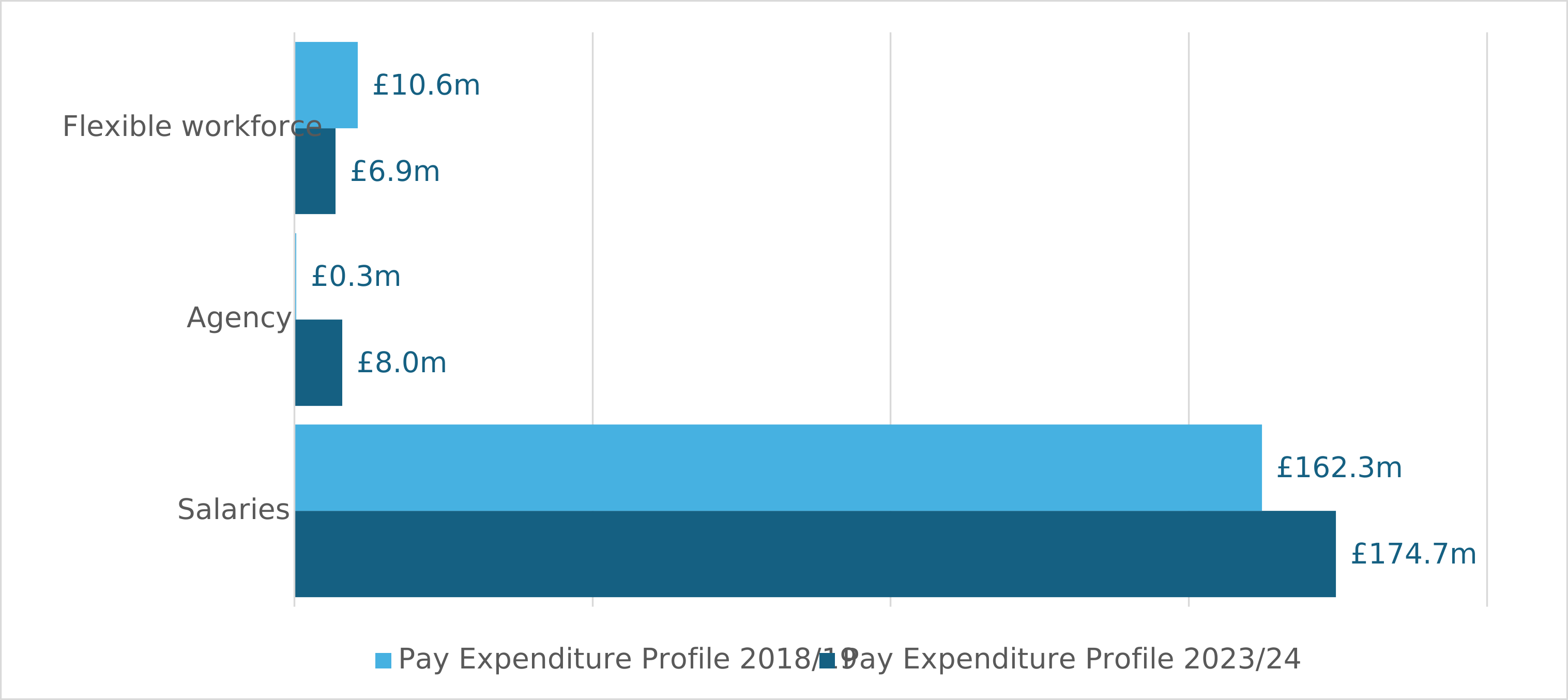
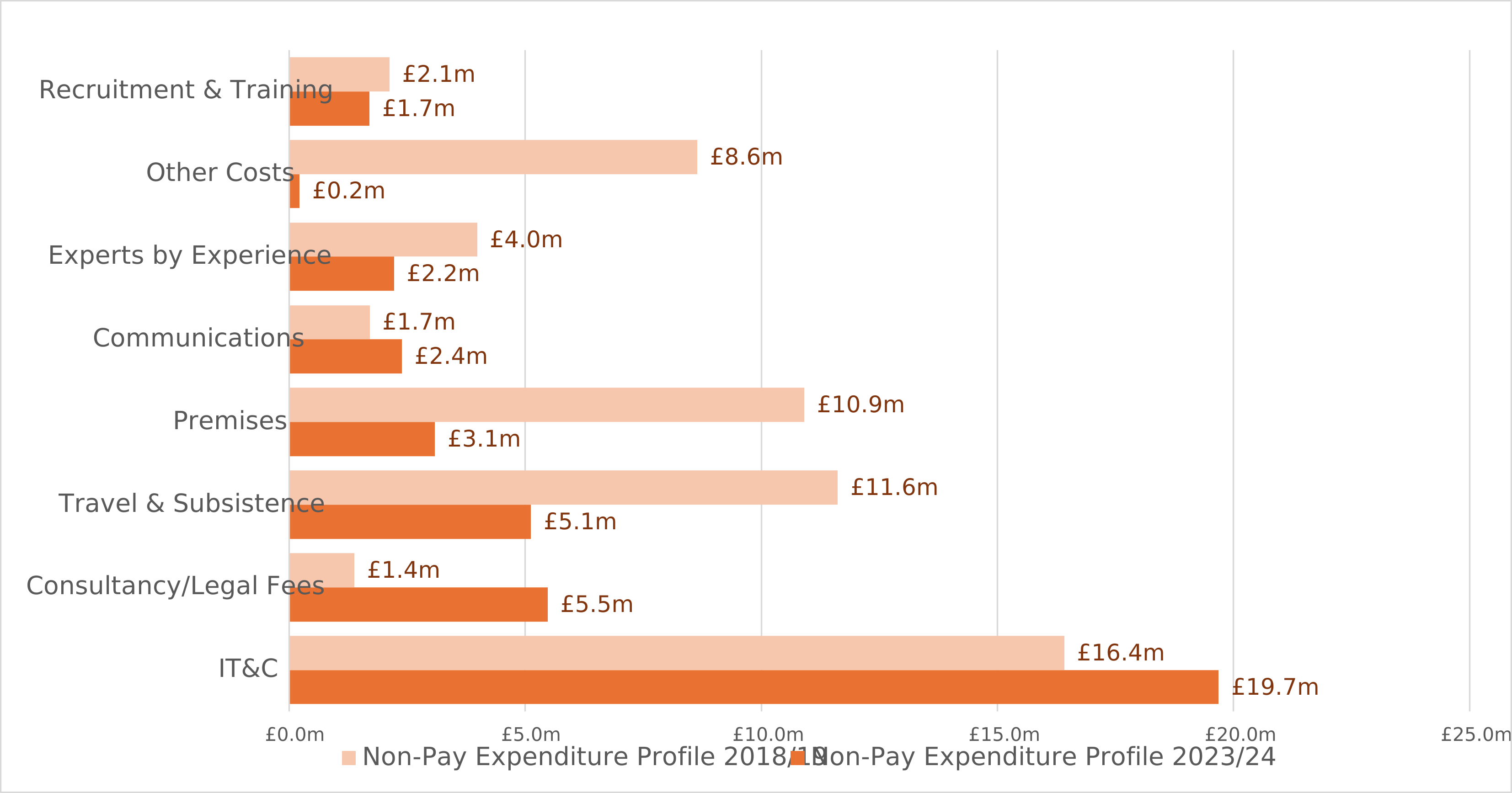
Figure 3: Revenue non-pay expenditure profile 2018/19 v 2023/24
Find out more about our financial performance in the Statement of Comprehensive Net Expenditure.
Our estate
During the year we:
- Served notice and vacated our Manchester office in December 2023.Desk space during the period was reduced from 12 to 1.
- Reduced our occupancy at Victoria House, Cambridge by approximately 50%.
- Provided accommodation for colleagues from the National Citizen Service (NCS) in our Stratford office from September 2023.
- Vacated our Bristol office at the end of March 2024.
The Government Property Agency (GPA) sets the policy and overall guidance for government departments and agencies for all property matters. GPA was the landlord in 3 of the office locations we occupied during the reporting year. The Department of Health and Social Care was the landlord of 4.
CQC office locations during the reporting year, and associated occupancy rates for the space we have through the relevant lease/agreement are as follows:
| Office | Location | Landlord | Office space | Average occupancy of CQC space 2023/24 |
|---|---|---|---|---|
| Redman Place | London | DHSC | Shared (with NICE, HRA, HFEA, HTA, NCS) | 38% |
| Citygate | Newcastle | GPA | Not shared | 28% |
| Quarry House | Leeds | DHSC | Shared (with DHSC) | 22% |
| Seaton House | Nottingham | DHSC | Shared (with DHSC and UKHSA) | 35% |
| Rivergate (vacated March 2024) | Bristol | DHSC | Shared (with DHSC) | 14% |
| McLaren Building | Birmingham | GPA | Not shared | 6% |
| Piccadilly Plaza (vacated December 2023) | Manchester | GPA | Shared (with NICE) | 22% |
Our sustainability
To ensure our Net Zero Plan is ambitious and covers our most up-to-date emissions, its baseline year for our reduction targets is set to our 2022/23 reporting year.
The data does not include the impact of utilities, waste, and paper. Only the impact of travel and ICT is included. The communal nature of the space we occupy makes it difficult for us to establish ownership over improvements or failings related to sustainability data. So, instead, we describe the state of sustainability in the narrative for the relevant operational areas in ‘Greening Government Commitment (GGCs).
GGCs: we have analysed our emissions and have graphed them within our Net Zero Plan against historical figures. This has allowed us to set ambitious future targets for reduction. These targets are to achieve net zero emissions ahead of the 2050 GGC target, as our current projections predict we can achieve this goal by the end of our 2030 reporting year.
The Net Zero Plan was designed to align with or surpass our GGC requirements, with the GGC-related sections being:
- travel
- ICT
- waste
- procurement
- climate change adaptation.
We are continuously working to ensure we can reduce emissions and improve the sustainability of these areas of our operations through our Net Zero Delivery Group (NZDG).
We do not need to adhere to some areas of the GGC reporting, so have not included specific actions or targets related to them. This is either because we don’t report responsibility for a particular GGC target, or because we don’t fit into the necessary criteria (for example, due to our lack of fleet, we have no need to convert to ULEVs).
To reduce our travel emissions, we have begun assessing the viability of our reduction plans and have set targets to complete them by 2025. These plans include knowledge-sharing initiatives and assessing the sustainability of the travel options currently available to colleagues.
The focus for minimising waste relates to our ICT equipment and paper waste specifically, as these are the 2 areas we have the most control over, and that we can improve on the most. For example, we will assess the viability of acquiring more equipment that can be repaired or upgraded in-house, and of digitise paper copies of CQC documents to reduce the quantity of paper being stored.
The inclusion of social value has been expanded in our procurement processes, with the sustainability manager taking part in assessing the social value of organisations during a tender process. The NZDG has plans to improve our procurement sustainability for example, by expanding on social value inclusion and improving our understanding of emissions relating to our supply chain to improve scope 3 emissions tracking.
Much like last year, because our estate has no green spaces, and because we do not intend to acquire any, we have not made any developments regarding nature or biodiversity at CQC.
We are working to improve our current understanding of climate change risks and how to manage them. Our Audit and Risk Assurance Committee (ARAC) discussed sustainability and climate change risks in its March session. The Net Zero Plan also has actions based specifically around researching, understanding, and managing our climate change risks.
Task Force on Climate Related Financial Disclosures
We have reported on the climate-related financial disclosures consistent with HM Treasury’s Task Force on Climate Related Financial Disclosures (TCFD)-aligned disclosure application guidance, which interprets and adapts the framework for the UK public sector. We consider both sustainability and its impact on the climate to be important for the organisation, so have complied with the TCFD Phase 1 recommended disclosures around:
- Governance - recommended disclosures (a) and (b)
- Metrics and Targets - recommended disclosure (b).
This is in line with the central government’s TCFD-aligned disclosure implementation timetable for Phase 1. We plan to expand on this reporting in the coming year to comply with Phase 2 requirements in line with the central government implementation timetable.
Sustainability governance
The sustainability manager manages governance around CQC’s climate-related issues and risks. However, due to the scope of these issues for all organisations, NZDG supports this work. Currently, no climate-related risks have been identified as being principal risks for CQC‘s consideration.
Board oversight of climate-related issues
The Board has nominated one of its members as a sustainability representative, who meets regularly with our Sustainability Manager to receive updates and to feed these back to the Board. An annual update is provided to Board. The Board sustainability representative is also a member of the Audit Risk and Assurance Committee (ARAC) that receives assurance on CQC’s risk management including matters relating to climate related risk.
Assessing and managing climate-related issues
CQC’s sustainability manager works with the NZDG, particularly the business continuity manager, to determine any necessary plans for climate-related risk management. The sustainability manager takes on primary responsibility for both climate-related issues and climate-risk management at CQC, with large-scale plans dependent on ARAC and Board approval. Our Executive team discussed climate-related issues more generally in October 2023, when signing off on the Net Zero Plan (a useful tool to help us manage any potential transition risks).
Sustainable procurement
Our internal procurement code outlines how we comply with commercial and procurement rules, internal and external delegated approvals and wider Government policy around commercial and procurement activities (including sustainable procurement), as well as driving good value for money outcomes.
Acknowledging the importance of sustainable procurement to achieve value for money and produce benefits for CQC, wider society and the economy whilst minimising environmental impacts. We build sustainable operations targets into all relevant contracts, as well as ensuring appropriate product standards are incorporated into our specifications, in support of delivering our obligations under wider Government commercial policies.
CQC ensures that proportionate evaluation criteria relating to sustainability and Net Zero are established and applies a minimum of 10% of evaluation criteria to this topic on all procurement activity above £180k. Our Commercial and Contracts Team also support delivery of our Net Zero Delivery Plan through their participation in our internal Net Zero Delivery Group.
We seek to consolidate requirements for goods, works and services to ensure that complimentary requirements are positioned to the market to drive value for money throughout the whole supply chain. We also maintain and develop relationships with other public bodies at a local, regional and national level to identify opportunities for commercial collaboration and on lessons learned. This will include elements of joint commissioning and shared approaches where this improves outcomes and offers better value for money.
Metrics and targets
Our Net Zero Plan sets out targets to achieve our organisation’s goal of becoming net zero. These targets are both quantitative and qualitative, with some specifically focused on reducing emissions and others based around improving sustainability awareness. Our quantitative metrics cover our Scope 1, 2, and 3 emissions. We have decided to disclose our Scope 3 emissions below, to ensure transparency and consistency with other bodies, and because they are our biggest and most controllable emissions.
CQC’s emissions are displayed in the ‘Sustainability data’ section. All data is calculated in line with Greenhouse Gas Protocol methodology, and using government-provided conversion factors.
Sustainable Development Goals: the main Sustainable Development Goals (SDG) that our actions contribute towards are:
- Sustainability Development Goal 12: to ensure sustainable consumption and production patterns, we contribute to SDG 12 through our targets to reduce consumption of paper, ink, and printers, and by using KOcycle, a zero-to-landfill organisation, for our ICT equipment.
- Sustainability Development Goal 15: protect, restore, and promote sustainable use of terrestrial ecosystems, sustainably manage forests, combat desertification, halt and reverse land degradation, and halt biodiversity loss. We contribute to SDG 15 through our work with KOcycle, which uses our contribution to support sustainable projects throughout the world that focus on sustainability education and the support of ecosystems.
Sustainability data
This section outlines sustainability data related to emissions and finances.
Like last year’s report, the following data shows the carbon dioxide-equivalent (tCO2e) that our activities generate.
Travel emissions
We have developed the following targets to reduce our travel emissions in the short and longer term against the baseline. It should be noted that our activity is demand-led and therefore targets should be considered in that light.
Short term targets by 2025:
- Reduce the emissions from air travel by, at least, 35% from the baseline
- Reduce the emissions from car travel by, at least, 20% from the baseline
- Reduce the emissions from rail travel by, at least, 15% from the baseline
Long-term targets by 2030:
- Reduce the emissions from air travel by, at least, 80% from the baseline
- Reduce the emissions from car travel by, at least, 70% from the baseline
- Reduce the emissions from rail travel by, at least, 60% from the baseline
- Offset the remaining emissions
| Distance (km) 2019/20 | Distance (km) 2022/23 | Distance (km) 2023/24 | Distance difference 2019/20 to 2023/24 (%) | |
|---|---|---|---|---|
| Domestic rail | 3,695,491 | 4,033,899 | 5,640,268 | +52.63% |
| Domestic air travel | 181,376 | 129,744 | 114,828 | -36.69% |
| International air travel | 1,326 | 44,950 | 97,029 | +7,217.42%* |
| Car use | 6,099,294 | 2,953,198 | 2,647,527 | -56.59% |
| Total travel distance | 9,977,487 | 7,161,791 | 8,499,652 | -14.81% |
* The significant increase in flights between 2019/20 and 2023/24 is largely due to an increase in international conference attendance and international site visits, such as inspection colleagues travelling to Cyprus for the Defence Medical Services inspection programme.
| Number of flights 2019/20 | Number of flights 2022/23 | Number of flights 2023/24 | |
|---|---|---|---|
| Domestic air travel | 274 | 210 | 148 |
| International air travel | 1 | 15 | 31 |
| Emissions (tCO2e) 2019/20 | Emissions (tCO2e) 2022/23 | Emissions (tCO2e) 2023/24 | Emissions difference 2019/20 to 2023/24 (%) | |
|---|---|---|---|---|
| Domestic rail | 152.07 | 143.16 | 200.02 | +31.53% |
| Domestic air travel* | 46.24 | 31.90 | 31.30 | -32.31% |
| International air travel* | 0.21 | 6.90 | 18.04 | +8,490.48%** |
| Car use | 1,102.20 | 519.41 | 456.59 | -58.57% |
| Total travel emissions | 1,300.72 | 701.37 | 705.95 | -45.73% |
* Emissions from flights include both direct (CO2, methane, and nitrous oxide) and indirect (non-CO2 emissions for example, water vapour, contrails, nitrous oxides) climate change impacts.
** The significant increase in flights between 2019/20 and 2023/24 is largely due to an increase in international conference attendance and international site visits, such as inspection colleagues travelling to Cyprus for the Defence Medical Services inspection programme.
Information and communication technology (ICT) emissions
We have developed the following targets to reduce our ICT emissions in the short and longer term against the baseline.
Short-term targets by 2025:
- Reduce overall ICT data emissions by 15% from the baseline
Long-term targets by 2030:
- Reduce overall ICT data emissions by 50% from the baseline
- Offset the remaining emissions
| Emissions (tCO2e) 2021/22* | Emissions (tCO2e) 2022/23 | Emissions (tCO2e) 2023/24 | Emissions difference 2021/22 to 2023/24 (%) | |
|---|---|---|---|---|
| Computacenter | 16.15 | 14.42 | 16.16 | +0.06% |
| Vodafone WAN | 3.60 | 2.64 | 3.14 | -12.78% |
| Vodafone LAN | 9.08 | 7.50 | 7.11 | -21.70% |
| Vodafone Wi-Fi | 14.04 | 11.72 | 9.43 | -32.83% |
| Data hosting | 30.57 | 25.20 | 39.63 | +29.64% |
| Total ICT emissions | 73.44 | 61.48 | 75.47 | +2.76% |
* 2021/22 reflects our increased confidence in our ICT data collection, hence its position as the comparison year.
We intend to continuously improve on the quality of our data collection by:
- Working with our Building Management teams, the Department of Health and Social Care, and the GPA to improve our estate data.
- Working with our Digital team and our third-party suppliers to generate more detailed reports on our ICT data.
- Setting internal targets and actions around data improvement through our NZDG.
Finances:
All the below figures refer to expenditure for our 2023/24 financial year.
| Estate expenditure | £ |
|---|---|
| Electricity | £24,481.43 |
| Water | £1,492.08 |
| Gas | £545.76 |
| Total | £26,519.27 |
| Travel expenditure | £ |
|---|---|
| Accommodation | £1,532,805 |
| Car parking | £94,336 |
| Default* | £771,468 |
| Flights | £40,854 |
| Foreign** | £1,254 |
| Mileage (car/motorcycle/bicycle) | £686,337 |
| Rail/bus travel | £1,800,108 |
| Subsistence | £190,716 |
| Taxi and other vehicle hire | £235,089 |
| Total | £5,352,967 |
* ‘Default’ refers to travel costs that we cannot define based on their transaction descriptions.
** ‘Foreign costs’ refers primarily to international flights, and secondarily to foreign hotels and foreign subsistence.
Security
The cyber security team managed 2,516 incidents of varying nature during the year, including incidents of:
- malware infections
- social engineering
- phishing
- data breaches
- account compromises
- network intrusions.
This is an increase of 963 compared with last year.
Phishing and social engineering attempts continue to affect CQC, and we receive a consistent number of reported incidents from colleagues throughout the year. Sophisticated phishing attempts using CQC branding are commonly used on malicious credential harvesting sites, making it more challenging to identify for affected colleagues.
We logged 150 malware incidents and 189 incidents for inappropriate use of IT. Incidents for inappropriate use of IT refer to general policy breaches, ranging from blocked URL access attempts to attempts to sign in on CQC devices outside the UK.
Hardware losses for the year have reduced, with 8 lost devices compared with 11 last year.
216 incidents were classified as data breaches, mostly minor in nature, but with 4 being assessed as reportable to the Information Commissioner’s Office (ICO), resulting in minor recommendations. We are using our updated online modules of required learning to help increase knowledge and awareness of data protection and the importance of colleague awareness. Two of the data breaches were human error whereby a colleague added the incorrect recipient to an email and breached personal data law. The other 2 were due to technical issues with the design of new IT systems, specifically the new regulatory platform and provider portal. A technical fix was implemented to both remediate the incident and prevent further data breaches.
Sir Julian Hartley
Chief Executive
14 July 2025