The state of health care and adult social care in England 2025/26
Downloads
Care and treatment for cancer
Cancer will affect 1 in 2 people during their lifetime.Macmillan Cancer Support estimates that there are almost 3.5 million people living with cancer in the UK, with more than 420,000 people diagnosed with cancer each year.
Last year, Cancer Research UK published research showing that since the 1970s, the 10-year survival rate for all cancers combined in England and Wales has doubled, from 24% for cases diagnosed in 1971/72 to 50% for those diagnosed in 2018. However, survival rates vary by the type of cancer, and data from NHS England shows that pancreatic cancer has the lowest 5-year survival rates – less than 10% for both males and females. This data also shows that for most cancers, survival is generally lower in patients diagnosed in areas that are the most deprived and higher in areas that are the least deprived.
Cancer treatment is more likely to be successful when people get an early diagnosis. This means that the cancer is spotted at an early stage, such as stage 1 or 2, when it is usually small and hasn’t spread to other parts of the body. In February 2026, the Department of Health and Social Care published its National Cancer Plan for England ,which sets out plans for transforming cancer care and outcomes in England by 2035. This includes improving and modernising the early detection pathway.
On its cancer advice page, NHS England recommends that if people are concerned about symptoms, they should contact their GP. GPs can refer people into secondary care for further investigation, diagnosis and treatment through an urgent suspected cancer (USC) referral.
The Fingertips dashboard from the Department of Health and Social Care reports the number of USC referrals, and how many of these result in a diagnosis of cancer, for all cancer types. If more people go through the diagnostic pathway, the proportion of people diagnosed with cancer will be lower, but there will be a higher chance of detecting a person with cancer.
Nationally, the proportion of people with a USC referral who are diagnosed with cancer (known as the conversion rate) has been falling since 2009/10. At the same time, new cancer cases treated following a USC referral (known as the detection rate) has increased. This suggests that more people are being referred for tests and, as a result, more cancers are being picked up. This varies by integrated care board (ICB) area across the country, with conversion rates ranging from a low of 3.7% to a high of 9.1% between 2020/21 and 2024/25.
Once referred for a test, the faster diagnosis standard states that 75% of people should receive either a diagnosis of cancer or have cancer ruled out within 28 days. This standard was increased to 80% in March 2026.
Results of NHS England’s National Cancer Patient Experience Survey 2025 showed that 78.1% said they felt the length of time waiting for diagnostic test results was about right (up from 77.5% in 2024).
At a national level, performance against the standard has remained largely unchanged since 2024/25, with 76.3% of people receiving a result within 28 days. Performance in March 2026 was 79.4%, narrowly missing the new 80% standard. At a local level, on average across 2025/26, 29 ICB areas met the target of 75% of people receiving a result in 28 days, of which 10 always met the target in 2025/26 (figure 29).
Figure 29: 29 out of 42 ICBs met the 28-day cancer diagnosis standard on average across 2025/26
Percentage of people receiving a cancer diagnosis or having cancer ruled out within 28 days, by integrated care board within each NHS region, 2025/26
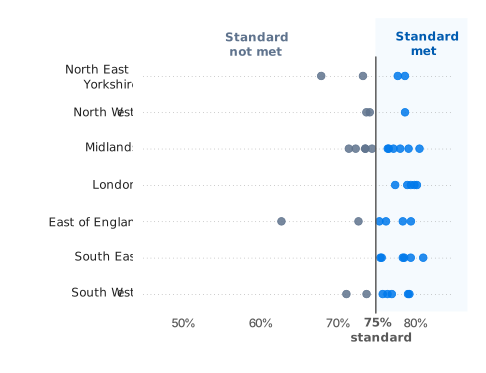
Source: NHS England Cancer waiting times statistics, 2025/26
The current standard is that 85% of people with an urgent referral should start treatment within 62 days. However, performance against this standard remains poorer than the other targets, with an average performance in 2025/26 of 69.4%, and it has not been met once by any integrated care board area in 2025/26. Performance also varies across the country from 80% in the highest performing areas to 50% in the lowest performing area (figure 30). As delays in treatment are associated with worse outcomes for patients, this is a blockage that needs to be addressed.
Figure 30: No integrated care board areas met the 85% standard for 62-day treatment on average in 2025/26
Percentage of people receiving urgent referral treatment within 62 days, by integrated care board within each NHS region, 2025/26
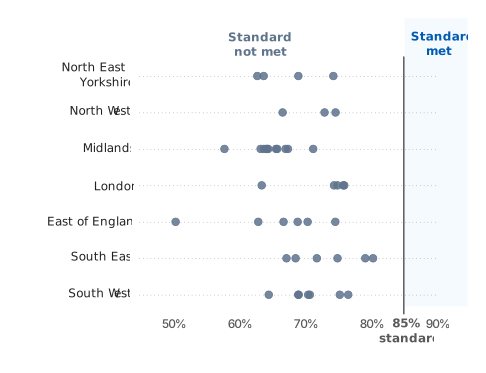
Source: NHS England Cancer Waiting Times Statistics, 2025/26