The state of health care and adult social care in England 2025/26
Downloads
GP practice ratings and patient satisfaction
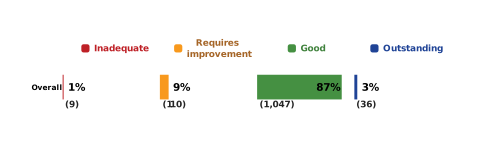
As at August 2026, 87% of the 1,202 GP practices assessed under our current assessment framework, from January 2024 onwards, are rated as good. A further 3% are rated as outstanding. The remaining GP practices are rated as requires improvement (9%) or inadequate (1%) (figure 1). For most of these assessments, we have prioritised assessing services where our data indicated there may be greater risk to the quality and safety of people’s care. However, since March 2026 we have been carrying out assessments of NHS GP practices that we consider to be lower risk under our Returning to good and outstanding programme, as a direct response to feedback from the sector for proportionate regulation.
Figure 1: Most GP practices are rated as good overall
GP services, overall ratings, August 2026
Source: CQC, ratings data
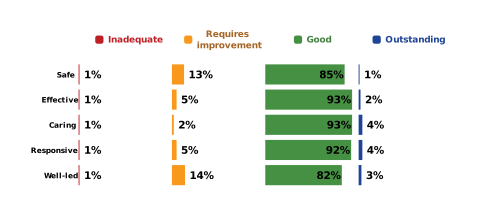
Where we see poorer performance, it is usually under the safe key question (13% requires improvement and 1% inadequate) or well-led key question (14% requires improvement and 1% inadequate). Across the effective, caring and responsive key questions, we see 95-97% of practices rated as either good or outstanding (figure 2).
Figure 2: GP performance is weaker under the safe and well-led key questions
GP services, key question ratings, August 2026
Source: CQC, ratings data.
Percentages may not add up to 100 due to rounding. Percentages between 0.01% and 1% have been rounded up to 1%.
The latest British Social Attitudes Survey, presented in a report by the Nuffield Trust, showed people’s overall satisfaction with GP services was at 35% and dissatisfaction was 45%. This is the highest level of satisfaction since 2021 and ends the downward trend of the past few years.
The survey also shows that respondents aged 65 and over were more likely (43%) to be satisfied with GP services than the 18-64 age group (33%). Those aged under 35 were the least satisfied group, with just 31% ‘very’ or ‘quite’ satisfied.
An increase in overall satisfaction is also reflected in the GP Patient Survey 2026, with 77% of people describing their overall experience as ‘good’ compared with 75% in 2025 and 74% in 2024.
People living in the most deprived areas are less likely to report a good overall experience of their GP practice than people living in the least deprived areas (74% and 79% respectively). People with dementia or Alzheimer’s disease and those who have had cancer in the last 5 years (83%) are most likely to say they have a good overall experience of their GP practice.
The most recent National Cancer Patient Experience Survey reported that 78% of respondents who had contacted their GP practice said they only spoke to a healthcare professional once or twice before they received their cancer diagnosis. 68% said that the referral for diagnosis from their GP practice was explained in a way they could completely understand, which is an improvement since the 2024 survey.
There has also been an improvement in how easy it is for people to contact their GP practice, with 73% of people describing their last experience of contacting their GP practice as ‘good’ compared with 70% in 2025 and 67% in 2024. Older people are more likely to report a better experience when contacting their GP practice than younger people (69% of 16-24 year olds report ‘good’ compared with 81% of those aged 85 and over). However, people living with frailty are less likely to report their experience of contacting their GP practice is good, as well as autistic people and people with a learning disability.
When asked how they last contacted their GP practice in 2026:
- most people (54%) used the telephone – a decrease from 62% in 2025 and 68% in 2024
- more people (31%) used online methods such as a practice website, NHS app or other online method – an increase compared with 22% in 2025 and 17% in 2024.
We discuss online methods more in the next section on patients’ needs.