The state of health care and adult social care in England 2025/26
Downloads
Access to mental health care
Rising demand for community mental health services
The pressure on mental health services has continued to rise in 2025/26, with increasing numbers of people needing support from services across the mental health pathway. Between 2024/25 and 2025/26, the average monthly number of referrals to secondary mental health services increased by 7% from 453,930 to 483,797, which is more than the increase of 6% we saw in the previous year (2023/24 to 2024/25).
In community mental health, the number of people with open referrals to services has also risen by 34% over the last 3 years, from 1.6 million on average each month in 2022/23 to 2.2 million each month in 2025/26. A ‘contact’ is defined as a care contact resulting from a referral, such as a face-to-face appointment, phone call, or home visit. The number of these contacts during the same period has also increased by 26%, from 2.3 million on average each month in 2022/23 to 2.9 million a month in 2025/26.
Since 2023, there has also been a steady rise in the numbers of people with severe mental illness who are accessing community mental health services. Severe mental illness refers to a group of conditions, including schizophrenia and bipolar disorder, whereby people’s ability to engage in functional and occupational activities is severely impaired. People with severe mental illness experience some of the widest health inequalities in England – guidance from NHS England highlights that their life expectancy is 15 to 20 years shorter than that of the general population, and that the gap is widening.
Between 2024/25 and 2025/26, the average number of people each month with severe mental illness who were accessing community mental health services for adults, and who had at least 2 care contacts in the previous year, rose by 6% from 640,619 to 681,149. This places additional pressure on community mental health services, given the complexity of care that is required to support people with severe mental illness.
Although there is an increase in both the numbers of people and contacts in community mental health services, it is not rising at the same rate. The average number of contacts for each person has decreased from 1.4 per person in 2022/23 to 1.3 in 2025/26. The reasons for this could include more people presenting with less severe needs, or people being referred inappropriately to community services. However, it could also reflect that staff are having to support more people and/or people are potentially not getting the care they need.
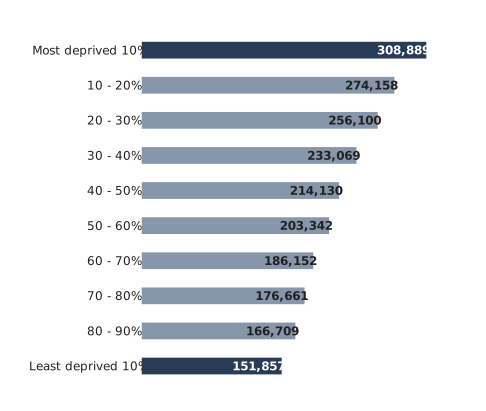
As demand for services increases, we continue to see that people who live in the areas with most deprivation have greater levels of need and more contact with mental health services. In 2025/26, each month an average of 308,889 people in the most deprived population decile had open referrals to community mental health services. This is double the amount of people in the least deprived decile, where on average 151,857 people had open referrals with services per month (figure 17).
Figure 17: The most deprived areas have twice the rate of community mental health service open referrals than least deprived
People with open referrals to community mental health service by deprivation decile, 2025/26
Source: NHS England, Mental Health Services Data Set
Data from 2024/25 shows that people with severe mental illness in the most deprived decile were over twice as likely to have accessed community mental health services at least twice in the previous year compared with those in the least deprived decile.
Similarly, we see inequality in care for people from ethnic minority groups, with highest rates for people with open referrals to services from the groups ‘any other mixed background’, ‘any other ethnic group’ and ‘any other Black background’.
Increasing need for mental health care can add to the pressure on services and could lead to ineffective care, or even to care not being given at all to those who need it. As well as creating a safety concern, not having the capacity to meet this increasing need risks widening inequalities.
Long waits for community mental health care
As reported in last year’s State of Care, alongside increasing demand for services, people are still waiting too long to receive the care they need from community mental health teams. Results from the 2025 Community mental health survey show that 39% of respondents felt the waiting time was too long between their assessment and first appointment for treatment. Where referrals remain open for extended periods without contact, there is an increased risk that changes in people’s needs may not be identified or appropriately supported quickly enough. This could potentially result in unmet needs and increased safeguarding risks.
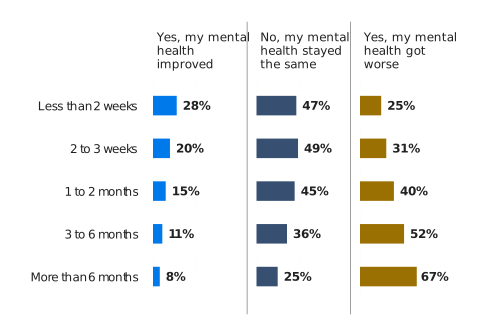
Longer waiting times also increase the likelihood of people’s mental health getting worse, potentially leading to them reaching crisis point or needing more intensive interventions later on. Results from the 2025 Community mental health survey found 67% of respondents who had waited more than 6 months said their mental health got worse while they waited, compared with a quarter (25%) of people who waited less than 2 weeks (figure 18).This was worse for respondents who had a disability, with nearly half (46%) reporting that their mental health deteriorated while waiting compared with those who did not have a disability (26%). One respondent described the impact of their long wait in the free text comments:
Once I was under the care of CAMHS I felt I had the right team around me but it took 6 months to get this … I got increasingly more ill until I was in a catatonic state before I finally was admitted under hospital care… Too many hoops to jump through whilst I was getting progressively more unwell.”
(Respondent to the 2025 Community mental health survey)
Figure 18: Longer waits are associated with worse mental health outcomes
Self-reported mental health outcomes by waiting time for community mental health services in 2025
Source: CQC, community mental health survey
Changing models for delivering care in the community
We continue to hear mixed feedback about changes to the way community mental health services are being commissioned and delivered, and the impact this is having on people. This is against the backdrop of more people with mental health needs and people finding it harder to access the services they need when they need them.
As part of our comprehensive programme of inspections of community mental health services for working-age adults, and crisis care we held engagement events with providers in late 2024. At the events, providers told us they were concerned about a lack of national guidance and standards for adult community mental health services. There were particular concerns about a lack of guidance around safe staffing levels, medicines management, caseload management, and a lack of focus on a proactive and longer-term approach to preventative care and recovery.
At our events in 2025, attendees again described the challenges facing community mental health services, and highlighted how there is no single model for delivering community mental health services in England. Providers described how they often felt that they were left to interpret national guidance alone, resulting in them “going off in different directions”. We heard this was leading to a patchwork of different service models, which varied widely depending on geography, demographics, commissioning arrangements, and workforce capacity. While some local variation allows providers to respond to different needs, there is a risk that variation driven by lack of national agreement on the most effective service models may contribute to inequalities in people’s access to care, experiences and outcomes.
However, to ensure they are meeting the needs of their local populations, providers told us that they are developing models of care that are responsive to these needs, including neighbourhood and place-based models of care. The aim of these models is to bring care closer to where their local population lives, often with walk-in access, extended hours, and co-located partners, such as the voluntary, community, faith and social enterprise (VCFSE) sector. For example, one attendee described how many of their VCFSE partners worked in the same building in a small rural town, which made it easier for people to access services at the hub. As well as being able to access VCFSE services, there were also a small number of beds at the hub to help people avoid hospital admission.
Other providers highlighted how working with the VCFSE sector was helping them to identify and meet the needs of people from different ethnic groups. For example, one attendee described how they had contracted the VCFSE sector to provide walk-in services on high streets, with the stipulation that the diversity of the local population must be reflected in the diversity of VCFSE staff. The attendee said that this decision had been successful and has changed the profile of people using the walk-in centres, including Black men. Following this, the provider was looking to ask the VCFSE organisation to introduce a Black family carers group.
This is supported by evidence from our inspections of adult community mental health services. For example, at one service, staff told us how they were working with their local community to remove barriers and improve access to services:
... the trust worked with a local charity to address mental health inequalities faced by the South Asian community... The project sought to address mental health inequality and inequity, by ensuring the South Asian population … were equipped with the knowledge, resources, and community support to address their mental health issues, and have equitable access to mental health services where needed.
(Inspection report for community-based mental health services for adults of working age)
However, a couple of providers told us that it was difficult to ‘scale up’ successful pilots. They described how many models of care are resource intensive and cannot be replicated across all localities without significant investment. This is supported by figures from NHS Providers' State of the Provider Sector Survey, which shows that 19% of mental health providers have de-prioritised spending on transformation initiatives, and a further 32% are considering doing so because of financial pressures. One provider at our engagement event also highlighted the risk that VCFSE-led hubs may attract people with lower level needs, while those with severe mental illness remain disengaged or unreached.
In May 2026, the government announced a call for evidence for the development of a new mental health strategy to support people with mental health conditions to live a full life and stay active in education, work, family life and their communities. The strategy is the next stage in the NHS 10-year plan and aims to transform care in England, driving the move towards prevention, and treating people earlier and faster in their local communities.
24/7 neighbourhood mental health centres
In July 2025, as part of its Quality Transformation Programme, NHS England announced the first 6 providers chosen to pilot a 24/7 neighbourhood mental health centre. These centres bring together a range of services under one roof, including crisis services, community mental health services and short-stay beds. People with severe mental illness, such as schizophrenia or bipolar disorder, will also be able to walk in without an appointment if they need mental health support, as well as advice on employment, housing, or volunteering.
Attendees at our 2025 provider engagement events spoke about the transformation of crisis and urgent care, describing how changes have meant that people are able to self-present without going to the emergency department. The use of short-stay beds was also said to have helped reduce inpatient admissions at one NHS trust.
During our inspections of emergency departments and medical wards over the winter of 2025/26, we interviewed leaders in mental health trusts to discuss the adult acute pathway. We spoke with one trust that is a pilot trust for a 24/7 neighbourhood service. The trust described how it works closely with local partners including primary care and mental health partners in the VCFSE sector. No referral is needed, and people are not discharged from the service. Leaders at the service told us they hope the service makes it easier for people to get help by reducing the barriers to care. The trust reported seeing a reduction in its home treatment team caseloads, and described how access to 4 short stay beds is leading to positive outcomes as it gives staff more time to assess people.
In another trust, a provider told us how the integrated 24/7 urgent care walk in service it runs had supported people to get access to the service they needed quickly and reduced pressures on the emergency department. Leaders felt that co-locating health and social care works well and enables people to get quicker access to support.
Tackling variation in access to care and health inequalities
Providers at our engagement event told us about their work to tackle variation in people’s access to care and health inequalities in their areas.
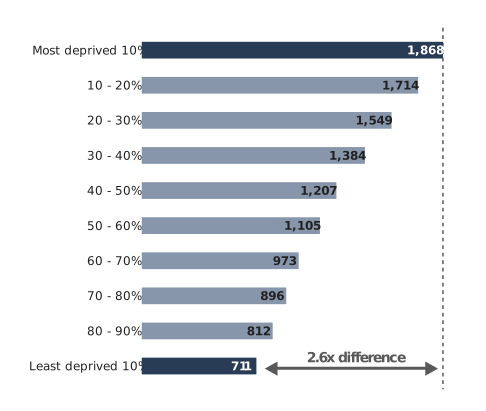
One specific area of concern for providers is meeting the needs of people living in more deprived areas. As noted above, people in this group have more needs than those in more affluent areas and their needs are also more likely to be more complex. In 2024/25, people living in the most deprived areas were 2.6 times more likely than people in the least deprived areas to have a severe mental illness and be accessing community mental health services. These people had at least 2 contacts with services in the previous year (rate of 1,868 per 100,000) compared with those in the least deprived area (rate of 711 per 100,000) (figure 19). This increases pressure on services, particularly where capacity and targeted support are insufficient, contributing to the widening of inequalities and poorer outcomes for people receiving services.
Figure 19: People in the most deprived areas were 2.6 times more likely to access community mental health services at least twice a year
Rates of people with a severe mental illness per 100,000 people accessing community mental health services at least twice in the previous year, by deprivation level, 2024/25.
Source: NHS England, Mental Health Bulletin
Some attendees described the challenges they faced operating in a region with areas of both affluence and deprivation, and the steps they were taking to make sure services were accessible to all. One provider described the differences within deprived areas, such as high rates of suicide in one area and people aged in their 40s who were living with frailty in another area. These providers have divided their trusts into separate areas, implementing their models of care differently in each area to better meet the needs of the population in those deprived areas.
Providers also highlighted Black men as a group who are disproportionately affected, because they are not accessing services, and are ultimately being subject to more restrictive practices. As we reported in last year’s State of Care, stigma can be a barrier for Black men in seeking help, disclosing symptoms and engaging with medicine – in terms of both the way communities often viewed mental illness as a sign of weakness or shame, and people’s past experiences that have led to distrust in services. Differing cultural beliefs and practices related to mental health and wellbeing can also lead to misunderstandings and misdiagnoses.
One attendee at our provider engagement events described the challenges of engaging Black people who use services in its region, which lacks a major urban centre. Describing its Black community as dispersed, the attendee said they were working with church groups and relevant community organisations to improve the accessibility of their mental health services.
Providers also shared their progress in implementing the Patient and Carer Race Equality Framework (PCREF). For example, one attendee described how their team is conducting in-reach work in Afro-Caribbean hairdressers as part of its PCREF and quality improvement work. Many attendees discussed how they used data and insight to identify inequalities and deliver services more effectively, using tools to generate insights about demographic groups as well as capture protected characteristics and identify any gaps in services.
However, some providers expressed a need to improve analysis and reporting processes, to enable a better understanding of their data.
This feedback is supported by early findings from our inspections of adult community mental health services, which have found variability in the progress around PCREF. Some of the trusts we inspected had published their self-assessment against PCREF and subsequent action plans, which included evidence of involving people with lived experience, communities and staff with their work, or they had embedded PCREF within their governance frameworks. We will continue to encourage services to embed PCREF through our regulatory and monitoring activity, and will be checking how services use the framework as evidence to inform our assessments.
Examples of progress we have seen through our adult community mental health inspections include one provider that had worked with Black Heritage Community organisations to support it to implement PCREF. Staff at another provider had improved their data collection on protected characteristics for patient experience and outcomes, including complaints, waiting times and admissions to services. Another trust worked with a neighbouring trust on implementing PCREF across its area and had participated in community engagement events to reduce racial inequalities. This trust had received praise from NHS England for its progress, particularly in the development of a local dashboard to help monitor inequalities.
As an organisation, we are committed to improving quality for everyone using health and care services. To better understand how providers are addressing inequalities, we will be continuing to improve how we understand equity, human rights and inequalities within local contexts. In mental health services, this includes aligning with principles in the Patient and Carer Race Equality Framework (PCREF).