Stockton-on-Tees Borough Council: local authority assessment
Downloads
Overall summary
Local authority rating and score
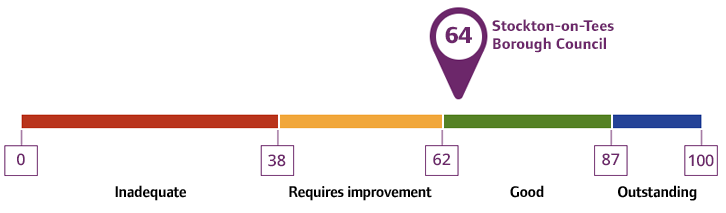
Quality statement scores
Summary of people's experiences
Peoples’ experiences of accessing adult social care were mixed. To facilitate ease of access to social care, the local authority had established a presence in some local community settings where people could meet with social care staff and complete their care assessments if they chose to do so. Some people said they were not always clear about referral pathways or how to ask for support from the local authority. Leaders recognised this, and they were taking steps to simplify the front door arrangements and to improve referral pathways so that people got to the right agencies more quickly and without the need to repeat their story.
Advice and information were provided to people about care and support provision in the area and community support workers were in place to assist with this. Additionally, a Stockton Information Directory resource provided people with information about non-statutory support. However, people funding their own care gave mixed feedback about how easily they could access community resources.
People had access to a range of services, facilities and resources to promote independence. We were told about examples where people had been supported into education and employment, and to obtain a tenancy. People could access equipment and minor home adaptations in a timely way to maintain their independence and continue living in their own homes.
People gave examples of person-centred, strength-focused approach to their care assessments and interaction with the local authority. However, people’s care act assessments and reviews were not always timely and up to date. The local authority was taking steps to reduce waiting times and to increase the number of contacts resolved at the front-door to adult social care.
The needs of unpaid carers were recognised as distinct from the needs of the person they cared for and assessment and support options were available. Carer’s feedback was mixed. Some carers gave positive examples of support, for example, some said they had an allocated local authority worker they could contact. However, others said they would have found more information about the support available useful. People spoke highly of the timeout service, and said it supported them in their caring role. The local authority acknowledged that further work was needed to fully understand unpaid carers’ needs and maximising support opportunities to support carers was a priority.
Support for hospital discharge was timely, although some people told us that communication with them did not always work well and this had led to a poor discharge experience.
There was a range of different care services and facilities in the area, and strategies and plans were in place to address any gaps in provision. For example, work was in train to resolve provision issues for those with complex care and support needs. These included for the re-provision of some existing underutilised care services, and investment into a service for people with a learning disability. Some strategies were set over the medium and longer term, particularly those relating to housing with care.
People had a timely response when concerns of a safeguarding nature were raised.
People with lived experience of using care services were being included in shaping current and future care and support provision, such as being members of the Making it Real Board and commissioning panels for care services. This helped the local authority to co-produce service decisions and to have a clear focus on people rather than just process. More work was being done to develop this.
Summary of strengths, areas for development and next steps
There had been leadership changes in the local authority over the previous two years, with the recruitment of a new Chief Executive, Director of Adults Health and Wellbeing, and Lead Cabinet Member for Adult Social Care.
The leadership team had good insight into its strengths and areas for improvement. They recognised the challenges presented by the changing demographics, entrenched high levels of inequality and deprivation in Stockton-on-Tees and the impact this had on people’s health and well-being outcomes. There was a strong commitment to addressing these challenges. Leaders recognised they were in the early stages of their transformation journey, and areas of risk were being addressed, for example, reducing the waiting times for Care Act assessments and care reviews and improving pathways and processes for young people moving into adulthood.
This was an identified priority improvement area. Other priorities were simplifying the arrangements and pathways at the first point of access, increasing the use of community assets to meet care and support needs, and increasing the strategic commissioning capability to deliver the long-term transformation strategy.
Risk monitoring and management arrangements were in place at corporate and directorate level. There was strategic oversight of wellbeing risks, however actions to address these were not always clearly defined. Good progress had already been made on the development of data dashboards, and these were now enabling real-time oversight of performance and more timely operational responses when risks were emerging.
There was good partnership working, and some relatively new multi-agency forums to support alignment of strategies and priorities across the borough and to address inequalities, including the Coalition of the Willing, Team Stockton and a refreshed approach to the Health and Well-Being Board. The foundations for co-production were in place, for example, the Making it Real Board provided a good basis on which to build this. Leaders acknowledged the need for continued focus in these areas to maintain momentum and embed the approaches and a specific role had been created to lead the coproduction work.
Staff showed commitment to supporting the borough’s most vulnerable residents and there was a strong and supportive culture. Leaders were visible and accessible.
People’s experience of accessing adult social care support was described as being mixed. Leaders acknowledged that the arrangements at the first point of contact were complicated, and they had started to work on simplifying it. There was also an ambition to increase the focus on preventative support through better use of community assets and to target formal support only when there was a clearly identified need.
People had mixed experiences of accessing and receiving support for their adult social care needs, and data showed that people were waiting to have a Care Act assessment. Processes were in place to manage risks to those waiting for care act assessments but leaders acknowledged there was work to do to reduce waits for care assessments and care reviews.
Assessment and support arrangements were in place for unpaid carers, but the local authority acknowledged the need to improve this and to improve ways to identify unpaid carers, particularly younger carers. The local authority was also seeking to improve the information and advice offer for people who were funding their own care. Some work had been undertaken to reshape the front door, but this was a work in progress and the impact had not yet come to fruition. There was a lack of clarity amongst the staff we spoke with about the next steps or timescales for the work.
The local authority worked with partners to deliver enablement support and effective hospital discharge processes, including an effective reablement service. Access to equipment and low-level home adaptations was mostly timely.
Uptake of direct payments was slightly higher than the England average. Local authority leaders were aware of challenges relating to recruitment and retention of Personal Assistants (PAs) and they were taking steps to support growth in this type of support. These included promotion initiatives for the role to address recruitment issues in partnership with local carers’ services.
Leaders understood there were gaps in some areas of provision leading to insufficient capacity to meet demand for some people, such as those with mental health needs, young people transitioning to adulthood and older people requiring accommodation with care options. Provision of sufficient suitable housing with care options was also limited in the borough. However, leaders told us arrangements were in place with neighbouring local authorities to provide speciality care to people that was not available in the borough. Plans were in the early stages of development, with options being explored for the re-provision of some existing underutilised care services, and for capital investment to fund new services, for example a new service for people with a learning disability.
There was an ambitious programme of commissioning activity planned for the short and medium term to address current gaps and to plan ahead to meet future needs. Leaders were seeking to develop its strategic commissioning capability to lead this programme of work.
The local authority was part of a Teeswide Safeguarding Adults Board (TSAB), at which learning was shared from Safeguarding Adults Reviews (SARs). Data showed that safeguarding responses were timely. There had been a significant increase in recorded safeguarding concerns, with a lower conversion rate of these referrals to Section 42 enquiries in comparison to previous years. Leaders told us this trend was a result of the local authority changing the way concerns were recorded.
Approaches to information governance and safety were strong and there was scrutiny processes and oversight of organisational risk. There was a strong focus on assurance of practice quality, with most teams describing a robust process of casefile audits, supervision, and oversight of practice.
The local authority promoted continuous professional development, and staff felt able to progress in the organisation. Staff spoke highly of the training and development opportunities offered by the local authority, and there were some notable areas of innovation among commissioned care providers. Further arrangements were needed to ensure learning from informal feedback and complaints was embedded into practice, but the local authority prioritised the early resolution of complaints, indicating a proactive approach to complaint management.