Oxfordshire County Council: local authority assessment
Downloads
Overall summary
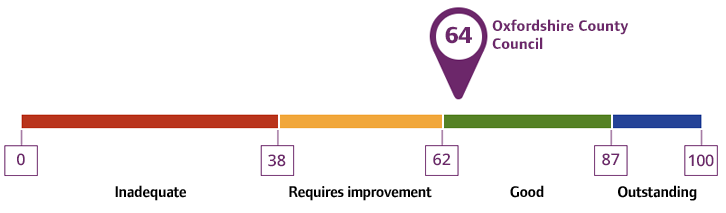
Local authority rating and score
Quality statement scores
Summary of people’s experiences
Overall, people had positive experiences of adult social care in Oxfordshire County Council, although there were some aspects that required further improvement. Many young people and their parents described positive experiences of transitions from children’s services to adult services, stating their needs were thoroughly assessed and considered with aspirational, ambitious conversations that led to a flexible approach to their care packages.
Staff were seen as person-centred and worked in a strength-based way, focusing on building relationships to address individual needs, which developed a sense of trust for some. Many people reported feeling involved in assessments and believed their desires and concerns were considered in the care planning process.
However, some carers described having mixed experiences of adult social care services. Some felt heard, supported and involved in the assessment process, while others highlighted inconsistencies in the support offered, especially in rural areas. This inconsistency created frustration and feelings of inequity. Some partners, such as voluntary sector organisations and providers, suggested improvements were needed in Care Act assessments to ensure a more person-centred approach, indicating that current assessment practices may not always capture the full spectrum of individual needs and preferences.
Some people highlighted information was provided to help them understand their options in a timely manner. Others felt there was a lack of communication, particularly around hospital discharge, which left their families unsure about what care provision and future support was available for the person who needed it. Some families spoken with described the hospital discharge process as rushed and said they would benefit from more discussion about planning for discharge. Both people and partners referred to inconsistencies across social care and health assessments prior to discharge, on occasions referring to the lack of detail in those assessments that could affect the support allocated by adult social care services following discharge.
Summary of strengths, areas for development and next steps
Oxfordshire County Council demonstrated strong strategic partnership working, particularly in facilitating the improved process of hospital discharge and supporting people to stay in their own homes. The Health Education and Social Care (HESC) commissioning team proved to be an asset, enabling shared budgets to facilitate collaborative work across health and social care, the outcome of which was smoother transitions and better integrated care.
The local authority had embarked on a period of change to embed the "Oxfordshire Way," which staff supported, as a strategy to improve service delivery and promote a more unified consistent approach across all areas of its work. Senior leaders had successfully communicated the vision of the Oxfordshire Way. The organisation continued to develop a consistent approach to meeting the needs of the diverse community and fully embedding the Oxfordshire Way. There were several strategies in development and planned future changes which would be pivotal to ensuring a strong preventative offer for people
The local authority had a clearly defined pathway for people to access its Social and Health Care Team (SHCT), a multidisciplinary team that included specialist customer service advisors, social workers, and occupational therapists. This team served as a central point of contact and facilitated access to a range of services.
Significant efforts had been made to reduce delays for assessments, resulting in tangible reductions in the time people waited to be seen and supported by the local authority. New processes and changes had been made to support the improvements. However, both providers and people who draw on care and support highlighted concerns with the level of detail in the assessments and the need for this to improve.
The local authority had improved systems and practices to safeguard people. Clear steps had been taken to reduce safeguarding backlogs, which positively affected the time people waited and improved the responsiveness of the safeguarding system. The authority had been responsive to learning through peer reviews and internal audits, which had created a positive willingness to embark on change and make improvements.
As of July 2024, the maximum wait for completion of Section 42 safeguarding enquiries was 54 days. The local authority told us significant concerns would be dealt with on the day they were received to mitigate any risk to individuals and all enquiries would be completed within 20 working days of allocation to a worker, which, in itself, could take up to 12 days. However, providers told us of their concerns related to a lack of responsiveness to safeguarding enquiries both in the management and communication around safeguarding. This may be because local teams must respond to safeguarding enquiries alongside their other work. The workforce was generally engaged and felt valued. Staff consistently spoke of their positive relationships with managers, and their ability to work flexibly and use their skills to work in a person-centred way. Staff and leaders engaged in external work, including research with the university and peer reviews, to drive performance. The authority utilised these opportunities to learn from others and improve its practices.
While progress was apparent, there were still gaps in ensuring consistent, high-quality care across the county. Providers and the local authority were aware of the gaps in service provision which was affecting particular groups. There were numerous areas where strategies were due to be developed, and this had left a gap in developing a clear strategic direction for formal support for areas such as mental health or autism.
The local authority worked well with partners who supported it to build knowledge of their communities. The local authority recognised there were gaps in fully understanding the needs of the community on a detailed level. Future developments with data were seen as an opportunity to ensure that strong evidence was developed to fully drive strategic direction.
Staff worked in a person-centred way and demonstrated areas of good practice. However, there was an absence of a consistent strategic approach to equality and diversity in service delivery. Partners felt there was a gap in addressing potential disparities in access and outcomes for marginalised groups. Some partners felt certain communities were harder to reach and engage with consistently, hindering the local authority’s ability to address the unique needs of these populations.
Most providers said that they had a positive working relationship with Oxfordshire County Council and had confidence in the senior management team.
The Quality Improvement (QI) Team used provider self-assessments as the first stage in the Provider Assessment and Market Management Solutions (PAMMS) review; this was then followed up by an on-site review where required. Strategic providers received more frequent reviews and interventions. Providers could generate a PAMMS self-assessment and were visited at least yearly by the QA team. Providers could generate a PAMMS self-assessment and were visited at least every 1-3 years by the QI team. However, some felt quality assurance checks did not always provide actionable feedback. This may suggest a need for the local authority to provide more detailed explanations to providers of how the quality assurance process works and how the Quality Improvement Team monitors providers to alleviate their concerns going forward.
Oxfordshire County Council demonstrated strengths in its governance and strategic planning, particularly through effective partnerships. The focus on a strengths-based, person-centred approach had been well received by staff who made clear attempts to embed learning. Stability in leadership had provided a solid foundation for ongoing progress.