Essex County Council local authority assessment (June 2025)
Downloads
Overall summary
Local authority rating and score
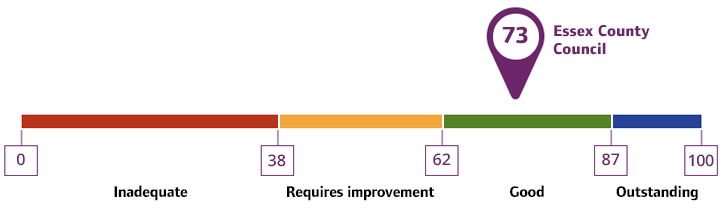
Quality statement scores
Summary of people’s experiences
People’s experience of Adult Social Care was mostly positive. People told us their Care Act 2014 assessments were person centered, completed in a timely way for them and they were able to understand the process. People told us they were included in their assessments and that others who they wanted to be involved were also included.
Evidence provided by the local authority showed peoples assessments were written in a person-centred way and sent to them after assessments had taken place. Assessments showed clear and concise pathways were used when support planning and peoples wishes were taken in to account.
Providers told us the local authority held meetings with them, the person who used the service, family and friends. Meetings were held together with the home, service user and other relevant parties when a review is arranged.
Direct payments were offered when a person was eligible to receive these, which was identified through a Care Act assessment or review. People told us they had direct payments for their own care needs, as well as some unpaid carers had their own direct payment for respite support from caring responsibilities.
Some people told us that they were not always recognised as an unpaid carer or offered a carers assessment. People told us the carers offer could be improved.
People told us there were delays with a review of their care needs, but the local authority were responsive to completing an assessment if a person’s needs had changed. The local authority had identified there were delays to reviews and had implemented changes to support the reduction in waiting times.
Summary of strengths, areas for development and next steps
At the time of assessment, the local authority had a stable political and adult social care leadership system in place. The local authority had a strong leadership team within Adult Social Care who had good knowledge of the Care Act 2014 legislation and the duties that were required to be carried out. They also had a Principal Social Worker and Principal Occupational Therapist (OT) in post to support practice and any models of change.
Adult social care within the local authority had 5 localities which within them have a number of neighbourhood teams and specialist locality teams which covered learning disabilities and autism, physical and sensory impairments and older people with mental health needs. Staff across all the teams told us they felt supported within their roles, and they had good access to leadership support and training. Staff were passionate about the work they did.
Partnership working and relationship building with the local authority and local partners was strong from front line workers up to leadership levels. Although, the local authority and partners had recognised this could be challenging at times due to the complexities of having 3 ICB’s and 12 district councils to work with.
In April 2024 the new carers core offer was launched after the local authority recognised this could be better. A coproduction exercise was carried out from October 2021 to August 2023 with unpaid carers to design the new offer. This was still an area of focus for the local authority to review and continued to be developed.
Disabilities Facilities Grants (DFG) were managed within each of the 12 district councils. Leaders told us it could be hard to ensure consistency with the spending of the DFG and more focus was needed to ensure consistency of spending of the grants. The local authority also had housing OT’s in post who worked closely with some of the district councils and could support with the DFG housing adaptations.
The local authority had waiting lists in place for care act assessments and had data oversight to monitor waiting times. They had developed risk prioritization systems and specified teams to focus on reducing waiting times. At the time of assessment this was continuing to be focused on.
Overall, the local authority had good structure and processes in place to enable people to be supported successfully, and support people to remain independent and live healthy lives. The workforce was passionate about supporting people to achieve these outcomes and the local authority had good knowledge of their area, the people living there and the demographics. They were also planning to the future to sustainably be able to support their population.