Cambridgeshire County Council local authority assessment (August 2025)
Downloads
Overall summary
Local authority rating and score
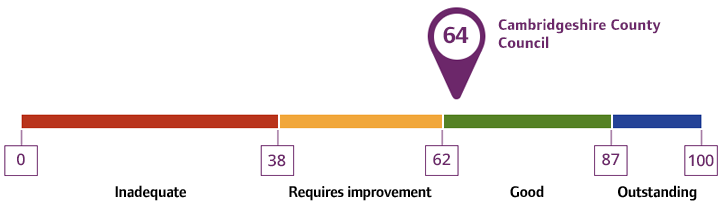
Quality statement scores
Summary of people's experiences
Most of the feedback from people about assessment, care planning and reviews was positive. This included positive feedback about a social worker supporting one person with autism and having the necessary communication skills to do this well. Other examples included people feeling supported, listened to and offered choices. One unpaid carer described the local authority as being responsive and very involved, with their views being respected.
Care was co-ordinated in a planned way considering people’s interests and what was important to them, which in one case included meeting the care and support needs of a pet in their care plan. People were supported overall in a timely way and information was provided in a format they could understand, being offered information, advice, technology and equipment where appropriate.
Some of the views of unpaid carers were more mixed, where people did not feel they were aware of the services available to support them, such as respite, or had not been able to access these. Other people had been supported with a carers assessment, carers conversation and an emergency ‘What if’ plan detailing what would happen if care and support was needed at short notice. Some people had set up private arrangements to support with care as they were not aware of what support could be accessed through the local authority.
Public transport challenges across the county could limit some people’s ability to access a range of services, however, other people told us they attended a local dementia café and another person a ‘hub,’ which they enjoyed and meant they could be supported by other people they met in similar situations. One person had wanted to access a direct payment to pay for an activity but did not think they were able to access this. Whilst others had found it difficult to employ a support worker when they did have a payment. Other people’s feedback about the quality of care services they received was generally good, describing their care as excellent and consistent in some examples.
Moving between services such as hospital to home was generally smooth, however some young people moving to adult services from children’s services felt the process could be better. People were given the opportunity to provide feedback on services at various opportunities to enable learning and improvement to take place where needed.
Summary of strengths, areas for development and next steps
People were supported with social care assessments and care planning in a timely way by staff who considered their strengths and goals. Reviews of people’s care was an area where there were some delays, however the local authority managed these by considering risk, prioritisation and utilising a process to ensure people were waiting well. A commissioned service supported unpaid carers to prevent needs escalating where possible, however we heard some mixed feedback about unpaid carers overall where people had not felt well supported in some cases. People in Cambridgeshire were supported to meet their non-eligible care needs, for example, being provided with information, advice and by staff utilising community navigators. Independent advocacy support was available to help people participate fully in care assessments and care planning processes, although at times some staff found it difficult to access this.
National data in relation to Cambridgeshire was the same as or slightly better than the England average in terms of prevention, reduction or delay of people’s needs. People gave some examples of where their needs had been prevented in escalating, however in some cases felt that further support could be provided, for example, in relation to transport challenges. ‘Care Together’ is a programme involving local voluntary agencies and social enterprises in delivering preventative services. People accessed reablement services to support them to achieve optimal independence and found equipment, technology and occupational therapy services to be good and timely. Direct payments was an area the local authority had identified could be improved further, and this was reflected in the national data, however a programme of work was underway to achieve this. Overall, information was provided to people in an accessible format which met their needs.
Although the local authority knew where the gaps were in their services and had an Equality, Diversity and Inclusion Strategy to identify actions required, staff, leaders and partners all felt there were still areas that needed improvement, including in relation to data collection and utilisation. Some work was underway to address where needs had been identified, including in relation to better support for LGBTQI+ communities and with additional funding made available for people with mental health needs, and staff worked creatively to support people as well as possible. Information was made available to people in accessible formats and work had been done by the local authority to ensure these were suitable. Staff were not always able to access interpreters in a timely way and feedback there was a limited resource for British Sign Language (BSL) interpreters.
Local authority staff understood the needs of their local communities however, wanted to improve data and intelligence gathering further to enable them to understand these better and future projections. Market shaping and commissioning took place and areas which had been identified of particular need were in relation to housing and extra care housing. There were some plans underway in relation to addressing this. The numbers of people placed out of the county for care were reducing and further work was planned to bring people back into Cambridgeshire if this was their preference. Feedback from partners was there was a lack of health and social care services for people with chronic, severe and enduring mental health needs. The local authority had clear arrangements to monitor the quality of the care and support services being commissioned and supported improvements where needed. Providers were supported to recruit and retain care staff with support to pay the Real Living Wage, training available through a care academy, and other support, for example, to help recruit international care staff.
Partnerships with the voluntary sector and health partners were strong despite some recent changes with the ending of a learning disability partnership. The local authority was involved in a number of areas of work, such as with unpaid carers and work in relation to high intensity users of services. The local authority commissioned five Partnership Boards to work with people on co-production. Partners also told us the local authority attended these Boards’ meetings and were described as responsive, showing a commitment to hearing the voices of those with lived experience. Senior staff told us about good system work with a drive for them and partners to be better at turning process into action. The benefit of shared data and care records between health and social care was reported as positive. Partnership work was evident around shared national objectives including in relation to funding such as continuing healthcare.
Contingency plans were in place to support unpaid carers in the event of an emergency along with a range of policies and procedures relating to care home closures and provider failures. Staff worked closely with health colleagues in supporting safe hospital discharges and had other systems in place to support people with a learning disability and autism in emergencies. A review was taking place in relation to the emergency duty team as staff shortages and lack of access to some resources meant staff could not always support in a timely way. Staff worked well with people and partners during transitions of young people with a learning disability and autistic people. Strategic work continued with the local authority and partners, and feedback was they would like to continue to do more joint work around areas such as admission avoidance.
Local authority staff were committed to making safeguarding personal using advocacy and other ways to empower people to be involved in decision making. A Multi-Agency Safeguarding Hub worked alongside front line teams to manage safeguarding referrals effectively. Staff were suitably skilled and supported to undertake safeguarding duties effectively. Plans were in place to recruit a new Safeguarding Adults Board chair following a re-organisation of the board membership, structure and priorities. Processes were in place to ensure learning took place from Safeguarding Adults Reviews. The Deprivation of Liberty Safeguards team had a number of people who were waiting for assessment, however had processes in place to manage waiting lists and maintain an oversight of risk.
There was a stable adult social care leadership team who were visible and capable with a positively changed culture at the local authority and in relation to the leadership team. Care Act duties were underpinned by a number of strategies and people with lived experience had been involved in the development of these. Staff were well supported by managers with opportunities to feedback to them and be involved in adult social care improvement projects. A number of staff equality networks and well-being initiatives were in place and these were valued. The local authority used data to monitor performance, risk and make improvements. There were arrangements to maintain the security, integrity and confidentiality of data, records and data management systems.
Co-production involving people with lived experience of using services was being used to develop and inform services and strategies, and examples were given to show where this had been successful in making changes and improvements for the benefit of people. The local authority sought feedback and learning from people and partners and this fed into shaping strategy, and future practice. The local authority monitored complaints and sought feedback, and we saw evidence of learning from these when things went wrong. There were a wide range of training and development opportunities available for staff, with staff being encouraged to pursue further education courses and development opportunities available.