Better regulation, better care: Consultation on improving how we assess and rate providers
Downloads
Part 2: How we make judgements and award ratings
We are responsible for registering, monitoring and assessing regulated health and care providers, and for taking action where we find failures in care.
Our ratings were introduced to provide the single, independent, authoritative assessment of the quality and safety of care provided by a service.
Ratings are based on the judgements of experienced, expert inspectors about whether services are safe, effective, caring, responsive to people’s needs and well-led. They consider the information we hold about a service, including the views of people who use services and the findings of others. We award ratings to reflect whether services are outstanding, good, require improvement or are inadequate.
Why we are proposing changes to how we make judgements and award ratings
When we introduced the single assessment framework in 2024, we also introduced a new way of making judgements and awarding ratings, using scoring.
Before introducing scoring, we awarded ratings for each of our key questions by looking at all the evidence collected for that key question and making a judgement against our rating characteristics.
Scoring was introduced to help us make consistent rating decisions using a more structured approach to making judgements. The aim was that scoring would provide more transparency about the quality and safety of services by showing a detailed position within the rating scale.
The scoring model was also intended to support our ambitions to deliver a faster and more flexible approach to rating. It was intended to enable us to change ratings for a provider more responsively at any time, by updating any score within the scoring model to reflect changes in performance data or other evidence.
Under the scoring approach, ratings for each of our key questions were awarded based on building up from quality statement scores, which were awarded on a scale of 1 to 4 (the scales are 1 = evidence shows significant shortfalls, 2 = evidence shows some shortfalls, 3 = evidence shows a good standard and 4 = evidence shows an exceptional standard).
Quality statement scores were themselves built up from scores awarded for each category of evidence collected within that quality statement (the 6 evidence categories are: people’s experience, feedback from staff and leaders, feedback from partners, observation, processes, and outcomes). The scores at each higher level were decided using a mathematical process based on calculating percentage scores.
Feedback from stakeholders and the independent reviews, along with our operational experience, has shown that the way scoring was implemented was too complex. How scoring worked wasn’t transparent enough to providers or the public, which made our rating judgements less clear. The scoring model was also too inflexible in how it balanced different types of evidence in the framework, and it limited the appropriate use of professional judgement in awarding ratings.
We propose to improve our approach to making judgements and awarding ratings by:
- Simplifying our rating approach, strengthening the role of informed, expert professional judgement and making our reports clearer and easier to use to support improvement in care.
- Supporting our inspection teams to deliver timely and expert inspections, publish reports that have an impact, drive improvement, and maintain strong and effective relationships with providers.
- Reviewing and clarifying our approach to following up assessments and updating rating judgements, including through developing clear principles around the frequency of assessing providers.
We are also considering whether we should make changes to the way we award ratings for NHS trusts and independent hospitals. We are seeking views in this consultation on how our current rating structure works, and whether changes would be desirable. The issues we are considering are:
- Whether we should re-introduce an overall trust-level quality rating, and trust-level ratings of all 5 key questions, for NHS trusts.
- Whether we should no longer award overall ratings for locations, for example for individual hospitals within an NHS trust.
We explain these possible changes further in the next section.
What will not change
Feedback shows that our ratings are valued by the public, providers and other partners as an accessible summary of the quality of the services that we assess and inspect.
For services that we rate, we will continue to award ratings for each of our 5 key questions: are services safe, effective, caring, responsive and well-led.
We will continue to award an overall rating for these services, with the overall rating based on the ratings for each of the 5 key questions. We will continue to do this with reference to the established rating principles, along with the use of our professional judgement.
Our current principles for aggregating key question ratings will also remain as they are, where each location or service receives a rating for each key question, which is then aggregated to provide an overall rating for each service (figure 2).
Figure 2: Illustration of key question and overall ratings

Some types of services that we regulate do not receive a rating, with examples including primary care dental services, children’s homes, medical laboratories and secure settings in the health and justice sector. This is because we do not have the legal powers to rate these services. Under our current model we do not provide scores for quality statements for these non-rated services. Instead, we provide a judgement of either ‘regulations met’ or ‘not all regulations met’ for all regulations related to each quality statement based on our assessment. Those quality statement judgements then inform the overall key question judgement.
We will continue this approach for non-rated services in the future. We will adapt our new assessment framework and methodology for these services, so that our approach is as consistent as possible with our approach for services that receive ratings.
What we propose to change
1. Simplifying our rating approach and strengthening the role of professional judgement
We intend to implement an approach to awarding ratings that clearly and simply reflects the quality of services.
To deliver this, we propose to no longer award separate scores underneath our key question ratings.
This is because we recognise that the current quality statement scores have created additional complexity.
Our intention is for rating characteristics to have a key role in our new approach to making judgements. As in our previous approach, when awarding ratings our inspection teams would consider all the evidence they collect under each key question and make a judgement with reference to the expectations of quality and safety described in the ratings characteristics that we propose to develop and publish.
We intend to report clearly and in a structured way, to support providers to understand our judgements, identify good and outstanding practice, and respond to areas for improvement. While we propose to no longer publish separate scores underneath our key question ratings, we intend to continue to be transparent about our findings in each area of the assessment framework to support providers to improve.
Our approach to aggregation may need to evolve in the future, but we recognise our priority right now is to establish an approach to awarding ratings that is clear and that we know gives confidence to, and works for the public, providers and our staff, along with other partners.
Figure 3 summarises the proposed changes to our approach to making judgements and awarding ratings.
Figure 3: Illustration of our proposed approach to making judgements and awarding ratings
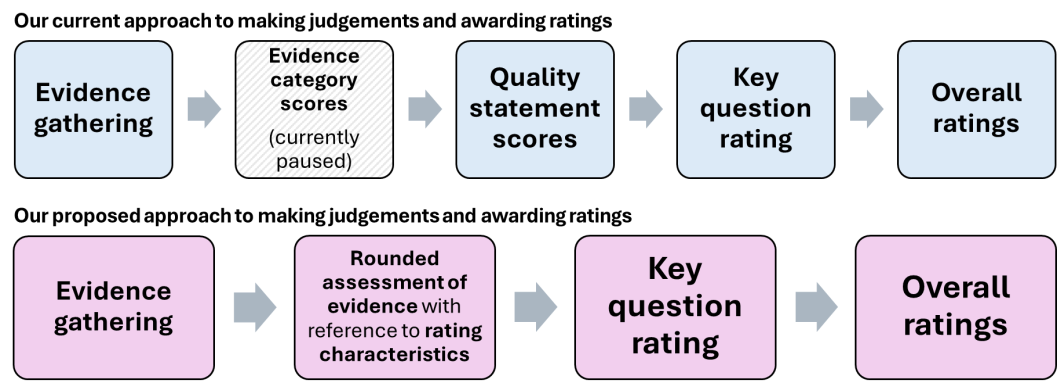
The diagram describes the following stages in our current approach to assessing and rating providers:
- Evidence gathering through inspection and other activity.
- Evidence category scores awarded (currently paused).
- Quality statement scores driven by evidence category scores and professional judgement.
- Key question rating driven directly by aggregated quality statement scores.
- Overall ratings based on aggregation from key question ratings and professional judgement.
We are proposing moving to a simpler approach:
- Evidence gathering through inspection and other activity.
- Rounded assessments of evidence collected across the whole key question, with reference to rating characteristics. We would no longer award scores for quality statements within each key question.
- Key question rating awarded based on professional judgement.
- Overall ratings awarded based on aggregation from key question ratings and professional judgement.
Consultation question 4: To what extent do you agree that we should award ratings directly at key question level with reference to rating characteristics?
Consultation question 4a: Do you have any comments or suggestions on our proposed approach to awarding ratings?
2. Supporting our inspection teams to deliver timely and expert inspections, publish impactful reports and develop strong relationships with providers
As well as making changes to our assessment frameworks and methodology, we know that we need to make other changes to our ways of working.
The independent reviews and other feedback have especially highlighted the need to improve the timeliness of our inspections, the clarity and impact of our inspection reports, and how we maintain relationships with the providers that we regulate.
As described above, we have already made significant progress in these areas, but we need to do more.
Information technology and our data and insight
We know that our current IT systems need to better support our internal colleagues as well as providers and stakeholders. We will develop and roll out replacement functionality to support our regulatory functions, including our assessment process over the coming months. As part of this work, we will redevelop the provider portal functionality and our registration systems, acknowledging feedback about the significant improvements we need to make. We are also examining how the data and insights that we generate from our regulatory work can be shared in a better way to enable providers and other stakeholders to use it to support improvements in health and care.
In making these changes, we will use the learning from our previous IT transformation programme. We will design our approach to developing new functionality by working closely with the people who will be using our digital systems to understand their requirements, including the public and providers of health and care services. We will adopt a thorough approach to user research to ensure our systems are user friendly, simple and safe to use, and that they provide the right functionality and have accessibility at their heart.
CQC has a role to encourage AI-enabled care, alongside other innovative practice, where it benefits people and services. We do not regulate or endorse AI technologies or products themselves, but will consider how a service uses AI in line with our existing regulations. To make this remit clear, we are currently developing a policy position statement on AI. This will articulate our role and remit, and the principles for the responsible use of AI in line with expectations around quality, safety and equity. We will engage with colleagues, providers and other stakeholders to develop our position statement, and aim to publish by spring 2026.
Skilled specialist inspection workforce
We have committed to specialist leadership around the sectors we regulate with 4 chief inspectors to lead on regulation and improvement of hospitals, mental health, primary and community care and adult social care services. The chief inspectors will lead specialist inspection teams with responsibility for each of their sectors.
As outlined in our commitment to providers and systems, professional relationships between ourselves and those we regulate, based on respect and trust, are central to helping to deliver our purpose. But however good our regulatory model, standards and processes are, our impact depends crucially on the people who implement and experience our regulation. We aim to ensure that we consider the impact of our work on the providers that we regulate, including the wellbeing of their staff.
Through our commitment to our people, we aim to continue to develop the skills of our workforce, with expertise in sectors, regulatory methods and relational skills. We recognise regulatory relationships with providers are important – particularly in terms of continuity, expertise, mutual respect, trust and confidence.
We intend to strengthen our approach to developing and maintaining ongoing relationships with the providers we regulate in each sector. In particular, we are working to ensure that large providers such as NHS trusts always have a clear point of contact within CQC with a member of our staff so they can discuss any issues in their service and their experience of our work. We are also exploring how we can improve our contact with other providers, depending on the type of services offered and information we have on quality and performance.
Alongside our Experts by Experience, continued use of our external professional advisors will be central to our approach, as they contribute vital specialist expertise and credibility. Our intention is that our inspections should wherever possible have joint input from our own expert inspectors and external experts (for example, clinicians, managers and Experts by Experience). This peer review element to our assessment approach is essential to the quality of our assessments, and also helps spread knowledge across the health and care system.
Clear, impactful inspection reports
We intend to co-design a new approach to inspection reports, to make them clearer and more useable for our audiences. We want to make sure our reports are structured and consistent in a way that make them easy to use.
We intend to produce narrative reports that reflect our assessments against the ratings characteristics. Reports will be structured so that performance is clear against each part of the assessment framework that we have assessed.
For the public, we intend to make sure our new inspection reports enable them to quickly and easily understand the quality of the services they use.
For providers, we want our inspection reports to provide detail of our judgements and support them to identify areas for positive change and continuous improvement. We recognise that providers need detail in our reports to understand why they have received a particular rating and to relate to other providers.
We intend to highlight areas of both good practice as well as where improvements are needed, including around inequalities of experience or unwarranted variation in outcomes for different groups of people.
Consultation question 5: Do you have any comments or suggestions for how we should support our inspection teams to deliver expert inspections, impactful reports and strong relationships with providers?
3. Reviewing and clarifying our approach to following up assessments and updating rating judgements
In our 2021 organisational strategy we set ourselves the ambitious aim of introducing a smarter regulatory model, including developing more dynamic and flexible regulation that provides up-to-date and high-quality information and ratings.
The introduction of scoring at evidence category and quality statement level, along with the mathematical aggregation used to drive key question rating judgements, was intended to support us to do this. Its aim was to adopt a more dynamic approach to updating ratings in response to smaller changes in performance data and the quality of services.
In introducing this approach, we said we would regularly review how well the new approach was working, and that we would publish a more detailed schedule for planned assessments. However, because of the operational and implementation issues described in the independent reviews, we have not yet been able to publish that detailed schedule.
As we introduce our new assessment approach based on the changes proposed in this consultation document, we will include an updated approach to planning assessments and updating our judgements, including how we use on-site inspections as part of our assessments of providers.
There will be 2 main types of inspection activity supporting our ongoing assessments of providers, as noted in the government’s 10 Year Health Plan for England:
- Routine planned inspections, where we plan to take a broad and detailed look at the quality and safety of the services. These inspections will generally take place on a 3 to 5-year cycle, depending on the type of service, and on information and changes in quality over time. We will consider evidence for both positive and negative changes in quality when planning and scheduling routine inspection activity.
- Rapid response inspections, where immediate and specific concerns are identified. Inspectors will be deployed to understand the nature and significance of problems and will focus on areas of particular risk.
We would not expect to look comprehensively at every area of every service or cover every part of the assessment framework every time we inspect a service. However, we would expect that routine planned inspections would normally cover all of our 5 key questions, so that we fully understand the quality of the service across the framework before updating our overall ratings.
We will ensure that we gather enough evidence to be assured of our judgements and may use tools such as sampling and pathway assessment. We will also consider other evidence gathered outside of an inspection in an assessment of a provider, as we do now. Furthermore, we will also consider the impact on ratings of significant quality failings that result in enforcement action.
When updating our ratings, we intend to minimise the mixing of new evidence with evidence gathered in previous inspections, especially where those inspections were carried out several years previously.
Our aim will be to ensure that when we update ratings for a service, our judgements are not affected by evidence or other ratings that are significantly out of date.
After we introduce our new approach to making judgements, we intend to introduce a frequency schedule for individual health and care sectors that takes into account previous ratings and other factors such as emerging risks. In planning assessments, we will consider the length of time since the service was last assessed, and evidence that the quality of the service may have improved. When inspecting large organisations with multiple services, we will normally prioritise services that previously had lower ratings. We may assess providers more frequently depending on their last rating if concerns are raised, or if reviews and complaints indicate a need for a more immediate assessment.
We will continue to carry out both announced and unannounced inspections. For care homes, we will normally carry out an unannounced inspection, but will return to speak to the registered manager if they are not available on the day of inspection. Assessments of the well-led key question at trust level will normally be announced to ensure that key people can be available.
Consultation question 6: To what extent do you agree with the approach to following up assessments and the principles for updating rating judgements?
Consultation question 6a: Do you have any comments on our proposed approach?
4. Potential changes to our approach to rating NHS trusts and independent hospitals
We are continuously reviewing and improving our approach to how we regulate and rate complex providers, including NHS trusts and independent hospitals. We are considering changes to how we award ratings for these providers and would welcome feedback on our current approach to rating and comments on whether we should consider changes.
When we introduced our current assessment frameworks and methodology, we also changed our approach to rating NHS trusts. This includes acute, mental health, community and ambulance NHS trusts. We began publishing a single rating for the well-led key question, which replaced our previous overall quality rating for NHS trusts. We also stopped publishing trust-level ratings for our other key questions, including the safe, effective, caring and responsive key questions.
The single trust-level well-led rating is based on our overall assessment of the organisation’s performance against the well-led key question, including findings from service-level assessments. Figure 4 shows our current approach to trust-level ratings.
Figure 4: Our current approach to location and trust-level ratings for NHS trusts
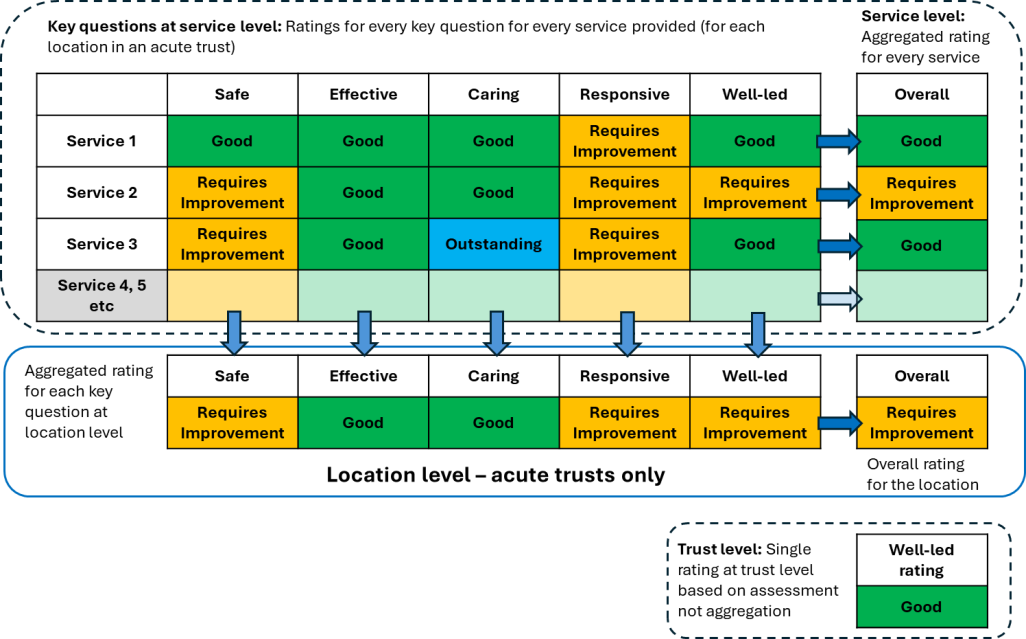
As shown in the diagram, our approach to rating NHS trusts and independent hospitals currently has several levels of ratings.
- Level 1: We give a rating for each key question at service level. For example, how safe a hospital’s surgery service is, or how effective the hospital’s maternity service is.
- Level 2: We give an aggregated overall rating for the service. For example, the rating for a surgery service at a hospital.
- Level 3: We give an aggregated rating for each key question at location level. For example, how safe a hospital is.
- Level 4: We give an aggregated overall rating for the location. For example, the rating for a hospital.
- Level 5: For NHS trusts, we also give an overall trust-level rating. This is based on the trust-level assessment of the quality statements under the well-led key question, alongside our assessment of the overall quality, safety and performance of the services that a trust delivers.
Our website provides full details of all our levels of ratings.
Overall trust ratings for NHS trusts
We are now considering changes to our approach to trust-level ratings. We are aware of the challenges of appropriately reflecting the quality and leadership of an NHS trust in a single well-led rating. We know that many of our stakeholders placed value on our previous overall quality rating for NHS trusts, and the previous structure of trust-level ratings.
We are therefore seeking feedback in this consultation on whether we should re-introduce an overall quality rating for NHS trusts, and a supporting structure of trust-level ratings of all 5 of our key questions. This potential rating structure is illustrated in Figure 5.
Figure 5: Illustration of overall trust quality rating and trust-level key question ratings

We would need to consider the best way of awarding the overall quality rating for a trust and trust-level key question ratings. This work would need to consider questions such as:
- the role of our existing rating aggregation principles in guiding our decisions
- how we take account of service and location-level ratings within a trust in determining trust-level key question ratings, especially in complex trusts that offer a wide range of services
- how we take account of wider organisational performance and direction of travel in awarding ratings.
Location ratings
We have listened to feedback on our current location-level ratings, and are considering whether to remove location-level aggregated ratings for NHS acute trusts and independent hospitals.
We know there are challenges with awarding location-level ratings. Aggregated ratings do not always reflect the way people experience services and care, which is increasingly delivered across hospital locations. We also know that aggregating a large number of different service ratings within a hospital location is complex, and could hide variations in the quality of services.
However, we also know that many patients and people using services have told us previously that they value a rating that shows the quality of care at the level of their local hospital, for example those that sit within a larger NHS trust.
We want to do some further work to explore whether assessing each hospital service in a trust separately in each location is still the most meaningful way to assess these services, or if some may be better assessed across locations or pathways.
We welcome views on these topics. Alongside this consultation, we will also carry out further engagement with our stakeholders on our definitions of the services that we assess and rate within trusts and how we assess them.
Consultation question 7a: To what extent would you support CQC in re-introducing an overall quality rating for NHS trusts and trust-level ratings of all 5 key questions?
Consultation question 7b: To what extent would you support CQC in no longer aggregating key question ratings to produce an overall rating for an individual hospital location?
Consultation question 7c: Do you have any comments to support your views, or suggestions for how we should award ratings for NHS trusts and independent hospitals?